# Coraye - The prerequisites (En)

# Table of prerequisites

### <span style="font-weight: 400;"><span style="vertical-align: inherit;"><span style="vertical-align: inherit;">Coraye training</span></span></span>

<span style="font-weight: 400;"><span style="vertical-align: inherit;"><span style="vertical-align: inherit;">In order to master the use of the software, it is necessary to acquire certain notions on color management and the various functions of Coraye. </span></span>  
<span style="vertical-align: inherit;"><span style="vertical-align: inherit;">To help you, we have created a table listing, by module, the skills you should have acquired.</span></span></span>

#### <span style="font-weight: 400;"><span style="vertical-align: inherit;"><span style="vertical-align: inherit;">Basic knowledge to be acquired by module </span></span></span>

<table id="bkmrk-%C2%A0-color-capture-colo" style="width: 749px;"><tbody><tr><td style="width: 206px;"> </td><td class="align-center" style="width: 76px;"><span style="font-weight: 400;">Color Capture</span>

</td><td class="align-center" style="width: 59px;"><span style="font-weight: 400;">Color Table</span>

</td><td class="align-center" style="width: 71px;"><span style="font-weight: 400;">Gamut Viewer</span>

</td><td class="align-center" style="width: 69px;"><span style="font-weight: 400;">Print Control</span>

</td><td class="align-center" style="width: 65px;"><span style="font-weight: 400;"><span style="vertical-align: inherit;"><span style="vertical-align: inherit;">Him Reader</span></span></span>

</td><td class="align-center" style="width: 69px;"><span style="font-weight: 400;">Spectral Viewer</span>

</td><td class="align-center" style="width: 71px;"><span style="font-weight: 400;">RGB Profiler</span>

</td><td class="align-center" style="width: 63px;"><span style="font-weight: 400;">CMYK Profiler</span>

</td></tr><tr><td style="width: 206px;">[<span style="font-weight: 400;">Coraye Installation</span>](https://wiki.coraye.com/books/coraye-manual-en/chapter/installation-and-maintenance "Installation Coraye")

</td><td class="align-center" style="width: 76px;"><span style="font-weight: 400;">✅</span>

</td><td class="align-center" style="width: 59px;"><span style="font-weight: 400;"><span style="vertical-align: inherit;"><span style="vertical-align: inherit;">✅</span></span></span>

</td><td class="align-center" style="width: 71px;"><span style="font-weight: 400;"><span style="vertical-align: inherit;"><span style="vertical-align: inherit;">✅</span></span></span>

</td><td class="align-center" style="width: 69px;"><span style="font-weight: 400;"><span style="vertical-align: inherit;"><span style="vertical-align: inherit;">✅</span></span></span>

</td><td class="align-center" style="width: 65px;"><span style="font-weight: 400;"><span style="vertical-align: inherit;"><span style="vertical-align: inherit;">✅</span></span></span>

</td><td class="align-center" style="width: 69px;"><span style="font-weight: 400;"><span style="vertical-align: inherit;"><span style="vertical-align: inherit;">✅</span></span></span>

</td><td class="align-center" style="width: 71px;"><span style="font-weight: 400;"><span style="vertical-align: inherit;"><span style="vertical-align: inherit;">✅</span></span></span>

</td><td class="align-center" style="width: 63px;"><span style="font-weight: 400;"><span style="vertical-align: inherit;"><span style="vertical-align: inherit;">✅</span></span></span>

</td></tr><tr><td style="width: 206px;">[<span style="font-weight: 400;"><span style="vertical-align: inherit;"><span style="vertical-align: inherit;">Light and color</span></span></span>](https://wiki.coraye.com/books/coraye-the-prerequisites-en/page/the-light-the-eye-the-color "Light and color")

</td><td class="align-center" style="width: 76px;"><span style="font-weight: 400;"><span style="vertical-align: inherit;"><span style="vertical-align: inherit;">✅</span></span></span>

</td><td class="align-center" style="width: 59px;"><span style="font-weight: 400;"><span style="vertical-align: inherit;"><span style="vertical-align: inherit;">✅</span></span></span>

</td><td class="align-center" style="width: 71px;"> </td><td class="align-center" style="width: 69px;"><span style="font-weight: 400;"><span style="vertical-align: inherit;"><span style="vertical-align: inherit;">✅</span></span></span>

</td><td class="align-center" style="width: 65px;"><span style="font-weight: 400;"><span style="vertical-align: inherit;"><span style="vertical-align: inherit;">✅</span></span></span>

</td><td class="align-center" style="width: 69px;"><span style="font-weight: 400;"><span style="vertical-align: inherit;"><span style="vertical-align: inherit;">✅</span></span></span>

</td><td class="align-center" style="width: 71px;"> </td><td class="align-center" style="width: 63px;"> </td></tr><tr><td style="width: 206px;">[<span style="font-weight: 400;"><span style="vertical-align: inherit;"><span style="vertical-align: inherit;">Additive synthesis</span></span></span>](https://wiki.coraye.com/books/coraye-the-prerequisites-en/page/additive-synthesis "Additive synthesis - RGB")

</td><td class="align-center" style="width: 76px;"><span style="font-weight: 400;"><span style="vertical-align: inherit;"><span style="vertical-align: inherit;">✅</span></span></span>

</td><td class="align-center" style="width: 59px;"><span style="font-weight: 400;"><span style="vertical-align: inherit;"><span style="vertical-align: inherit;">✅</span></span></span>

</td><td class="align-center" style="width: 71px;"><span style="font-weight: 400;"><span style="vertical-align: inherit;"><span style="vertical-align: inherit;">✅</span></span></span>

</td><td class="align-center" style="width: 69px;"><span style="font-weight: 400;"><span style="vertical-align: inherit;"><span style="vertical-align: inherit;">✅</span></span></span>

</td><td class="align-center" style="width: 65px;"><span style="font-weight: 400;"> </span>

</td><td class="align-center" style="width: 69px;"> </td><td class="align-center" style="width: 71px;"><span style="font-weight: 400;"><span style="vertical-align: inherit;"><span style="vertical-align: inherit;">✅</span></span></span></td><td class="align-center" style="width: 63px;"> </td></tr><tr><td style="width: 206px;">[<span style="font-weight: 400;"><span style="vertical-align: inherit;"><span style="vertical-align: inherit;">Subtractive synthesis</span></span></span>](https://wiki.coraye.com/books/coraye-the-prerequisites-en/page/subtractive-synthesis "Subtractive synthesis - CMYK")

</td><td class="align-center" style="width: 76px;"><span style="font-weight: 400;"><span style="vertical-align: inherit;"><span style="vertical-align: inherit;">✅</span></span></span>

</td><td class="align-center" style="width: 59px;"><span style="font-weight: 400;"><span style="vertical-align: inherit;"><span style="vertical-align: inherit;">✅</span></span></span>

</td><td class="align-center" style="width: 71px;"><span style="font-weight: 400;"><span style="vertical-align: inherit;"><span style="vertical-align: inherit;">✅</span></span></span>

</td><td class="align-center" style="width: 69px;"><span style="font-weight: 400;"><span style="vertical-align: inherit;"><span style="vertical-align: inherit;">✅</span></span></span>

</td><td class="align-center" style="width: 65px;"><span style="font-weight: 400;"> </span>

</td><td class="align-center" style="width: 69px;"> </td><td class="align-center" style="width: 71px;"> </td><td class="align-center" style="width: 63px;"><span style="font-weight: 400;"><span style="vertical-align: inherit;"><span style="vertical-align: inherit;">✅</span></span></span></td></tr><tr><td style="width: 206px;"><span style="font-weight: 400;"><span style="vertical-align: inherit;"><span style="vertical-align: inherit;">Color communication</span></span></span>

</td><td class="align-center" style="width: 76px;"><span style="font-weight: 400;"><span style="vertical-align: inherit;"><span style="vertical-align: inherit;">✅</span></span></span>

</td><td class="align-center" style="width: 59px;"><span style="font-weight: 400;"><span style="vertical-align: inherit;"><span style="vertical-align: inherit;">✅</span></span></span>

</td><td class="align-center" style="width: 71px;"><span style="font-weight: 400;"><span style="vertical-align: inherit;"><span style="vertical-align: inherit;">✅</span></span></span>

</td><td class="align-center" style="width: 69px;"><span style="font-weight: 400;"><span style="vertical-align: inherit;"><span style="vertical-align: inherit;">✅</span></span></span>

</td><td class="align-center" style="width: 65px;"><span style="font-weight: 400;"><span style="vertical-align: inherit;"><span style="vertical-align: inherit;">✅</span></span></span>

</td><td class="align-center" style="width: 69px;"> </td><td class="align-center" style="width: 71px;"> </td><td class="align-center" style="width: 63px;"> </td></tr><tr><td style="width: 206px;">[<span style="font-weight: 400;"><span style="vertical-align: inherit;"><span style="vertical-align: inherit;">The dependent color modes: RGB, CMYK</span></span></span>](https://wiki.coraye.com/books/coraye-the-prerequisites-en/page/the-dependent-color-modes-rgb-cmyk "The dependent color modes: RGB, CMYK")

</td><td class="align-center" style="width: 76px;"><span style="font-weight: 400;">✅</span>

</td><td class="align-center" style="width: 59px;"><span style="font-weight: 400;"><span style="vertical-align: inherit;"><span style="vertical-align: inherit;">✅</span></span></span>

</td><td class="align-center" style="width: 71px;"><span style="font-weight: 400;"><span style="vertical-align: inherit;"><span style="vertical-align: inherit;">✅</span></span></span>

</td><td class="align-center" style="width: 69px;"><span style="font-weight: 400;"><span style="vertical-align: inherit;"><span style="vertical-align: inherit;">✅</span></span></span>

</td><td class="align-center" style="width: 65px;"> </td><td class="align-center" style="width: 69px;"> </td><td class="align-center" style="width: 71px;"> </td><td class="align-center" style="width: 63px;"> </td></tr><tr><td style="width: 206px;">[<span style="font-weight: 400;"><span style="vertical-align: inherit;"><span style="vertical-align: inherit;">Independent color modes: Lab, Lch, XYZ</span></span></span>](https://wiki.coraye.com/books/coraye-the-prerequisites-en/page/independent-color-modes-lab-lch-xyz "Independent color modes: Lab, Lch, XYZ")

</td><td class="align-center" style="width: 76px;"><span style="font-weight: 400;"><span style="vertical-align: inherit;"><span style="vertical-align: inherit;">✅</span></span></span>

</td><td class="align-center" style="width: 59px;"><span style="font-weight: 400;"><span style="vertical-align: inherit;"><span style="vertical-align: inherit;">✅</span></span></span>

</td><td class="align-center" style="width: 71px;"><span style="font-weight: 400;"><span style="vertical-align: inherit;"><span style="vertical-align: inherit;">✅</span></span></span>

</td><td class="align-center" style="width: 69px;"><span style="font-weight: 400;"><span style="vertical-align: inherit;"><span style="vertical-align: inherit;">✅</span></span></span>

</td><td class="align-center" style="width: 65px;"> </td><td class="align-center" style="width: 69px;"> </td><td class="align-center" style="width: 71px;"> </td><td class="align-center" style="width: 63px;"> </td></tr><tr><td style="width: 206px;">[<span style="font-weight: 400;"><span style="vertical-align: inherit;"><span style="vertical-align: inherit;">Spectral values</span></span></span>](https://wiki.coraye.com/books/coraye-the-prerequisites-en/page/spectral-values "Spectral values")

</td><td class="align-center" style="width: 76px;"><span style="font-weight: 400;"><span style="vertical-align: inherit;"><span style="vertical-align: inherit;">✅</span></span></span>

</td><td class="align-center" style="width: 59px;"><span style="font-weight: 400;"><span style="vertical-align: inherit;"><span style="vertical-align: inherit;">✅</span></span></span>

</td><td class="align-center" style="width: 71px;"> </td><td class="align-center" style="width: 69px;"> </td><td class="align-center" style="width: 65px;"><span style="font-weight: 400;"><span style="vertical-align: inherit;"><span style="vertical-align: inherit;">✅</span></span></span>

</td><td class="align-center" style="width: 69px;"><span style="font-weight: 400;"><span style="vertical-align: inherit;"><span style="vertical-align: inherit;">✅</span></span></span>

</td><td class="align-center" style="width: 71px;"> </td><td class="align-center" style="width: 63px;"> </td></tr><tr><td style="width: 206px;">[<span style="font-weight: 400;"><span style="vertical-align: inherit;"><span style="vertical-align: inherit;">The density</span></span></span>](https://wiki.coraye.com/books/coraye-manual-en/page/show-density "The density")

</td><td class="align-center" style="width: 76px;"><span style="font-weight: 400;"><span style="vertical-align: inherit;"><span style="vertical-align: inherit;">✅</span></span></span>

</td><td class="align-center" style="width: 59px;"> </td><td class="align-center" style="width: 71px;"> </td><td class="align-center" style="width: 69px;"> </td><td class="align-center" style="width: 65px;"> </td><td class="align-center" style="width: 69px;"> </td><td class="align-center" style="width: 71px;"> </td><td class="align-center" style="width: 63px;"> </td></tr><tr><td style="width: 206px;">[<span style="font-weight: 400;"><span style="vertical-align: inherit;"><span style="vertical-align: inherit;">ICC Profiles</span></span></span>](https://wiki.coraye.com/books/coraye-the-prerequisites-en/page/icc-profiles "Les Profiles ICC")

</td><td class="align-center" style="width: 76px;"><span style="font-weight: 400;"><span style="vertical-align: inherit;"><span style="vertical-align: inherit;">✅</span></span></span>

</td><td class="align-center" style="width: 59px;"><span style="font-weight: 400;"><span style="vertical-align: inherit;"><span style="vertical-align: inherit;">✅</span></span></span>

</td><td class="align-center" style="width: 71px;"><span style="font-weight: 400;"><span style="vertical-align: inherit;"><span style="vertical-align: inherit;">✅</span></span></span>

</td><td class="align-center" style="width: 69px;"><span style="font-weight: 400;"><span style="vertical-align: inherit;"><span style="vertical-align: inherit;">✅</span></span></span>

</td><td class="align-center" style="width: 65px;"> </td><td class="align-center" style="width: 69px;"> </td><td class="align-center" style="width: 71px;"><span style="font-weight: 400;"><span style="vertical-align: inherit;"><span style="vertical-align: inherit;">✅</span></span></span>

</td><td class="align-center" style="width: 63px;"><span style="font-weight: 400;"><span style="vertical-align: inherit;"><span style="vertical-align: inherit;">✅</span></span></span></td></tr><tr><td style="width: 206px;">[<span style="vertical-align: inherit;"><span style="vertical-align: inherit;">Reference color spaces</span></span>](https://wiki.coraye.com/books/coraye-the-prerequisites-en/page/reference-color-spaces "Reference color spaces")

</td><td class="align-center" style="width: 76px;"><span style="font-weight: 400;"><span style="vertical-align: inherit;"><span style="vertical-align: inherit;">✅</span></span></span>

</td><td class="align-center" style="width: 59px;"><span style="font-weight: 400;"><span style="vertical-align: inherit;"><span style="vertical-align: inherit;">✅</span></span></span>

</td><td class="align-center" style="width: 71px;"><span style="font-weight: 400;"><span style="vertical-align: inherit;"><span style="vertical-align: inherit;">✅</span></span></span>

</td><td class="align-center" style="width: 69px;"><span style="font-weight: 400;"><span style="vertical-align: inherit;"><span style="vertical-align: inherit;">✅</span></span></span>

</td><td class="align-center" style="width: 65px;"> </td><td class="align-center" style="width: 69px;"> </td><td class="align-center" style="width: 71px;"><span style="font-weight: 400;"><span style="vertical-align: inherit;"><span style="vertical-align: inherit;">✅</span></span></span>

</td><td class="align-center" style="width: 63px;"><span style="font-weight: 400;"><span style="vertical-align: inherit;"><span style="vertical-align: inherit;">✅</span></span></span>

</td></tr><tr><td style="width: 206px;">[<span style="vertical-align: inherit;"><span style="vertical-align: inherit;">Non-reproducible colors</span></span>](https://wiki.coraye.com/link/260#bkmrk-les-couleurs-non-rep "Non-reproducible colors")

</td><td class="align-center" style="width: 76px;"><span style="font-weight: 400;"><span style="vertical-align: inherit;"><span style="vertical-align: inherit;">✅</span></span></span>

</td><td class="align-center" style="width: 59px;"><span style="font-weight: 400;"><span style="vertical-align: inherit;"><span style="vertical-align: inherit;">✅</span></span></span>

</td><td class="align-center" style="width: 71px;"><span style="font-weight: 400;"><span style="vertical-align: inherit;"><span style="vertical-align: inherit;">✅</span></span></span>

</td><td class="align-center" style="width: 69px;"><span style="font-weight: 400;"><span style="vertical-align: inherit;"><span style="vertical-align: inherit;">✅</span></span></span>

</td><td class="align-center" style="width: 65px;"> </td><td class="align-center" style="width: 69px;"> </td><td class="align-center" style="width: 71px;"><span style="font-weight: 400;"><span style="vertical-align: inherit;"><span style="vertical-align: inherit;">✅</span></span></span>

</td><td class="align-center" style="width: 63px;"><span style="font-weight: 400;"><span style="vertical-align: inherit;"><span style="vertical-align: inherit;">✅</span></span></span>

</td></tr><tr><td style="width: 206px;">[<span style="font-weight: 400;">The Gamut</span>](https://wiki.coraye.com/books/coraye-the-prerequisites-en/page/the-gamut "Le Gamut")

</td><td class="align-center" style="width: 76px;"><span style="font-weight: 400;"><span style="vertical-align: inherit;"><span style="vertical-align: inherit;">✅</span></span></span>

</td><td class="align-center" style="width: 59px;"> </td><td class="align-center" style="width: 71px;"><span style="font-weight: 400;"><span style="vertical-align: inherit;"><span style="vertical-align: inherit;">✅</span></span></span>

</td><td class="align-center" style="width: 69px;"> </td><td class="align-center" style="width: 65px;"> </td><td class="align-center" style="width: 69px;"> </td><td class="align-center" style="width: 71px;"><span style="font-weight: 400;"><span style="vertical-align: inherit;"><span style="vertical-align: inherit;">✅</span></span></span>

</td><td class="align-center" style="width: 63px;"><span style="font-weight: 400;"><span style="vertical-align: inherit;"><span style="vertical-align: inherit;">✅</span></span></span>

</td></tr><tr><td style="width: 206px;">[<span style="font-weight: 400;"><span style="vertical-align: inherit;"><span style="vertical-align: inherit;">The Delta E</span></span></span>](https://wiki.coraye.com/books/coraye-the-prerequisites-en/page/the-delta-e "The Delta E")

</td><td class="align-center" style="width: 76px;"><span style="font-weight: 400;"><span style="vertical-align: inherit;"><span style="vertical-align: inherit;">✅</span></span></span>

</td><td class="align-center" style="width: 59px;"><span style="font-weight: 400;"><span style="vertical-align: inherit;"><span style="vertical-align: inherit;">✅</span></span></span>

</td><td class="align-center" style="width: 71px;"><span style="font-weight: 400;"><span style="vertical-align: inherit;"><span style="vertical-align: inherit;">✅</span></span></span>

</td><td class="align-center" style="width: 69px;"><span style="font-weight: 400;"><span style="vertical-align: inherit;"><span style="vertical-align: inherit;">✅</span></span></span>

</td><td class="align-center" style="width: 65px;"> </td><td class="align-center" style="width: 69px;"> </td><td class="align-center" style="width: 71px;"> </td><td class="align-center" style="width: 63px;"> </td></tr><tr><td style="width: 206px;"><span style="font-weight: 400;"><span style="vertical-align: inherit;"><span style="vertical-align: inherit;">The Delta Ch, H, L</span></span></span>

</td><td class="align-center" style="width: 76px;"> </td><td class="align-center" style="width: 59px;"> </td><td class="align-center" style="width: 71px;"> </td><td class="align-center" style="width: 69px;"><span style="font-weight: 400;"><span style="vertical-align: inherit;"><span style="vertical-align: inherit;">✅</span></span></span>

</td><td class="align-center" style="width: 65px;"> </td><td class="align-center" style="width: 69px;"> </td><td class="align-center" style="width: 71px;"> </td><td class="align-center" style="width: 63px;"> </td></tr><tr><td style="width: 206px;">[<span style="font-weight: 400;"><span style="vertical-align: inherit;"><span style="vertical-align: inherit;">How a spectrophotometer works</span></span></span>](https://wiki.coraye.com/books/coraye-the-prerequisites-en/page/measuring-instruments "How a spectrophotometer works")

</td><td class="align-center" style="width: 76px;"><span style="font-weight: 400;"><span style="vertical-align: inherit;"><span style="vertical-align: inherit;">✅</span></span></span>

</td><td class="align-center" style="width: 59px;"> </td><td class="align-center" style="width: 71px;"> </td><td class="align-center" style="width: 69px;"><span style="font-weight: 400;"><span style="vertical-align: inherit;"><span style="vertical-align: inherit;">✅</span></span></span>

</td><td class="align-center" style="width: 65px;"><span style="font-weight: 400;"><span style="vertical-align: inherit;"><span style="vertical-align: inherit;">✅</span></span></span>

</td><td class="align-center" style="width: 69px;"> </td><td class="align-center" style="width: 71px;"><span style="font-weight: 400;"><span style="vertical-align: inherit;"><span style="vertical-align: inherit;">✅</span></span></span>

</td><td class="align-center" style="width: 63px;"><span style="font-weight: 400;"><span style="vertical-align: inherit;"><span style="vertical-align: inherit;">✅</span></span></span>

</td></tr><tr><td style="width: 206px;">[<span style="font-weight: 400;">Standard and Observer illuminants</span>](https://wiki.coraye.com/books/coraye-the-prerequisites-en/page/standard-and-observer-illuminants "Les illuminants standards et Observer")

</td><td class="align-center" style="width: 76px;"><span style="font-weight: 400;"><span style="vertical-align: inherit;"><span style="vertical-align: inherit;">✅</span></span></span>

</td><td class="align-center" style="width: 59px;"><span style="font-weight: 400;"><span style="vertical-align: inherit;"><span style="vertical-align: inherit;">✅</span></span></span>

</td><td class="align-center" style="width: 71px;"> </td><td class="align-center" style="width: 69px;"><span style="font-weight: 400;"><span style="vertical-align: inherit;"><span style="vertical-align: inherit;">✅</span></span></span>

</td><td class="align-center" style="width: 65px;"><span style="font-weight: 400;"><span style="vertical-align: inherit;"><span style="vertical-align: inherit;">✅</span></span></span>

</td><td class="align-center" style="width: 69px;"> </td><td class="align-center" style="width: 71px;"><span style="font-weight: 400;"><span style="vertical-align: inherit;"><span style="vertical-align: inherit;">✅</span></span></span>

</td><td class="align-center" style="width: 63px;"><span style="font-weight: 400;"><span style="vertical-align: inherit;"><span style="vertical-align: inherit;">✅</span></span></span>

</td></tr><tr><td style="width: 206px;">[<span style="font-weight: 400;">Modes M0, M1, M2, M3</span>](https://wiki.coraye.com/books/coraye-the-prerequisites-en/page/m0-m1-m2-m3-modes "Les modes M0, M1, M2, M3")

</td><td class="align-center" style="width: 76px;"><span style="font-weight: 400;"><span style="vertical-align: inherit;"><span style="vertical-align: inherit;">✅</span></span></span>

</td><td class="align-center" style="width: 59px;"> </td><td class="align-center" style="width: 71px;"> </td><td class="align-center" style="width: 69px;"><span style="font-weight: 400;"><span style="vertical-align: inherit;"><span style="vertical-align: inherit;">✅</span></span></span>

</td><td class="align-center" style="width: 65px;"> </td><td class="align-center" style="width: 69px;"> </td><td class="align-center" style="width: 71px;"><span style="font-weight: 400;"><span style="vertical-align: inherit;"><span style="vertical-align: inherit;">✅</span></span></span>

</td><td class="align-center" style="width: 63px;"><span style="font-weight: 400;"><span style="vertical-align: inherit;"><span style="vertical-align: inherit;">✅</span></span></span>

</td></tr><tr><td style="width: 206px;">[<span style="vertical-align: inherit;"><span style="vertical-align: inherit;">Presentation of Coraye</span></span>](https://wiki.coraye.com/books/coraye-manual-en/page/introduction-53c "Presentation of Coraye de Coraye")

</td><td class="align-center" style="width: 76px;"><span style="font-weight: 400;"><span style="vertical-align: inherit;"><span style="vertical-align: inherit;">✅</span></span></span>

</td><td class="align-center" style="width: 59px;"><span style="font-weight: 400;"><span style="vertical-align: inherit;"><span style="vertical-align: inherit;">✅</span></span></span>

</td><td class="align-center" style="width: 71px;"><span style="font-weight: 400;"><span style="vertical-align: inherit;"><span style="vertical-align: inherit;">✅</span></span></span>

</td><td class="align-center" style="width: 69px;"><span style="font-weight: 400;"><span style="vertical-align: inherit;"><span style="vertical-align: inherit;">✅</span></span></span>

</td><td class="align-center" style="width: 65px;"><span style="font-weight: 400;"><span style="vertical-align: inherit;"><span style="vertical-align: inherit;">✅</span></span></span>

</td><td class="align-center" style="width: 69px;"><span style="font-weight: 400;"><span style="vertical-align: inherit;"><span style="vertical-align: inherit;">✅</span></span></span>

</td><td class="align-center" style="width: 71px;"><span style="font-weight: 400;"><span style="vertical-align: inherit;"><span style="vertical-align: inherit;">✅</span></span></span>

</td><td class="align-center" style="width: 63px;"><span style="font-weight: 400;"><span style="vertical-align: inherit;"><span style="vertical-align: inherit;">✅</span></span></span>

</td></tr><tr><td style="width: 206px;">[<span style="font-weight: 400;"><span style="vertical-align: inherit;"><span style="vertical-align: inherit;">Sample measurements</span></span></span>](https://wiki.coraye.com/books/coraye-manual-en/page/capture-a-color "Sample measurement")

</td><td class="align-center" style="width: 76px;"><span style="font-weight: 400;"><span style="vertical-align: inherit;"><span style="vertical-align: inherit;">✅</span></span></span>

</td><td class="align-center" style="width: 59px;"> </td><td class="align-center" style="width: 71px;"> </td><td class="align-center" style="width: 69px;"> </td><td class="align-center" style="width: 65px;"> </td><td class="align-center" style="width: 69px;"> </td><td class="align-center" style="width: 71px;"> </td><td class="align-center" style="width: 63px;"> </td></tr><tr><td style="width: 206px;"><span style="font-weight: 400;"><span style="vertical-align: inherit;"><span style="vertical-align: inherit;">Import swatches into </span></span>[<span style="vertical-align: inherit;"><span style="vertical-align: inherit;">Photoshop</span></span>](https://wiki.coraye.com/books/coraye-manual-en/page/export-to-adobe-photoshop "Photoshop swatches import / export")<span style="vertical-align: inherit;"><span style="vertical-align: inherit;"> and </span></span>[<span style="vertical-align: inherit;"><span style="vertical-align: inherit;">Illustrator</span></span>](https://wiki.coraye.com/books/coraye-manual-en/page/export-to-adobe-illustrator "Import / export Illustrator swatches")</span>

</td><td class="align-center" style="width: 76px;"> </td><td class="align-center" style="width: 59px;"><span style="font-weight: 400;"><span style="vertical-align: inherit;"><span style="vertical-align: inherit;">✅</span></span></span>

</td><td class="align-center" style="width: 71px;"> </td><td class="align-center" style="width: 69px;"> </td><td class="align-center" style="width: 65px;"> </td><td class="align-center" style="width: 69px;"> </td><td class="align-center" style="width: 71px;"> </td><td class="align-center" style="width: 63px;"> </td></tr><tr><td style="width: 206px;">[<span style="font-weight: 400;"><span style="vertical-align: inherit;"><span style="vertical-align: inherit;">Use a color chart in PhotoShop</span></span></span>](https://wiki.coraye.com/books/coraye-manual-en/page/example-of-using-a-color-table-with-photoshop "Use a color chart in PhotoShop")

</td><td class="align-center" style="width: 76px;"> </td><td class="align-center" style="width: 59px;"><span style="font-weight: 400;"><span style="vertical-align: inherit;"><span style="vertical-align: inherit;">✅</span></span></span>

</td><td class="align-center" style="width: 71px;"> </td><td class="align-center" style="width: 69px;"> </td><td class="align-center" style="width: 65px;"> </td><td class="align-center" style="width: 69px;"> </td><td class="align-center" style="width: 71px;"> </td><td class="align-center" style="width: 63px;"> </td></tr><tr><td style="width: 206px;">[<span style="font-weight: 400;"><span style="vertical-align: inherit;"><span style="vertical-align: inherit;">Import of color charts in a RIP</span></span></span>](https://wiki.coraye.com/books/coraye-manual-en/page/importing-a-color-chart-into-a-rip "Import of color charts in a RIP")

</td><td class="align-center" style="width: 76px;"> </td><td class="align-center" style="width: 59px;"><span style="font-weight: 400;"><span style="vertical-align: inherit;"><span style="vertical-align: inherit;">✅</span></span></span>

</td><td class="align-center" style="width: 71px;"> </td><td class="align-center" style="width: 69px;"><span style="font-weight: 400;"><span style="vertical-align: inherit;"><span style="vertical-align: inherit;">✅</span></span></span>

</td><td class="align-center" style="width: 65px;"> </td><td class="align-center" style="width: 69px;"> </td><td class="align-center" style="width: 71px;"> </td><td class="align-center" style="width: 63px;"> </td></tr><tr><td style="width: 206px;">[<span style="font-weight: 400;"><span style="vertical-align: inherit;"><span style="vertical-align: inherit;">Management of color charts</span></span></span>](https://wiki.coraye.com/books/coraye-manual-en/page/color-table "Color table")

</td><td class="align-center" style="width: 76px;"> </td><td class="align-center" style="width: 59px;"><span style="font-weight: 400;"><span style="vertical-align: inherit;"><span style="vertical-align: inherit;">✅</span></span></span>

</td><td class="align-center" style="width: 71px;"> </td><td class="align-center" style="width: 69px;"> </td><td class="align-center" style="width: 65px;"> </td><td class="align-center" style="width: 69px;"> </td><td class="align-center" style="width: 71px;"> </td><td class="align-center" style="width: 63px;"> </td></tr><tr><td style="width: 206px;"><span style="font-weight: 400;"><span style="vertical-align: inherit;"><span style="vertical-align: inherit;">Pantones color charts</span></span></span>

</td><td class="align-center" style="width: 76px;"> </td><td class="align-center" style="width: 59px;"><span style="font-weight: 400;"><span style="vertical-align: inherit;"><span style="vertical-align: inherit;">✅</span></span></span>

</td><td class="align-center" style="width: 71px;"><span style="font-weight: 400;"><span style="vertical-align: inherit;"><span style="vertical-align: inherit;">✅</span></span></span>

</td><td class="align-center" style="width: 69px;"><span style="font-weight: 400;"><span style="vertical-align: inherit;"><span style="vertical-align: inherit;">✅</span></span></span>

</td><td class="align-center" style="width: 65px;"> </td><td class="align-center" style="width: 69px;"> </td><td class="align-center" style="width: 71px;"> </td><td class="align-center" style="width: 63px;"> </td></tr><tr><td style="width: 206px;">[<span style="vertical-align: inherit;"><span style="vertical-align: inherit;">Creation of a color chart intended to be printed</span></span>](https://wiki.coraye.com/books/coraye-manual-en/page/create-a-printable-swatch "Creation of a printable color chart")

</td><td class="align-center" style="width: 76px;"> </td><td class="align-center" style="width: 59px;"><span style="font-weight: 400;"><span style="vertical-align: inherit;"><span style="vertical-align: inherit;">✅</span></span></span>

</td><td class="align-center" style="width: 71px;"> </td><td class="align-center" style="width: 69px;"> </td><td class="align-center" style="width: 65px;"> </td><td class="align-center" style="width: 69px;"> </td><td class="align-center" style="width: 71px;"> </td><td class="align-center" style="width: 63px;"> </td></tr><tr><td style="width: 206px;">[<span style="font-weight: 400;"><span style="vertical-align: inherit;"><span style="vertical-align: inherit;">Preparation of a color chart for cutting</span></span></span>](https://wiki.coraye.com/books/coraye-manual-en/page/prepare-to-print-and-cut-a-color-chart "Preparation of a color chart for cutting")

</td><td class="align-center" style="width: 76px;"> </td><td class="align-center" style="width: 59px;"><span style="font-weight: 400;"><span style="vertical-align: inherit;"><span style="vertical-align: inherit;">✅</span></span></span>

</td><td class="align-center" style="width: 71px;"> </td><td class="align-center" style="width: 69px;"> </td><td class="align-center" style="width: 65px;"> </td><td class="align-center" style="width: 69px;"> </td><td class="align-center" style="width: 71px;"> </td><td class="align-center" style="width: 63px;"> </td></tr><tr><td style="width: 206px;">[<span style="font-weight: 400;"><span style="vertical-align: inherit;"><span style="vertical-align: inherit;">Preparation of a metallic color chart </span></span></span>](https://wiki.coraye.com/books/coraye-manual-en/page/prepare-a-color-chart-for-metallic-printing "Preparation of a metallic color chart ")

</td><td class="align-center" style="width: 76px;"> </td><td class="align-center" style="width: 59px;"><span style="font-weight: 400;"><span style="vertical-align: inherit;"><span style="vertical-align: inherit;">✅</span></span></span>

</td><td class="align-center" style="width: 71px;"> </td><td class="align-center" style="width: 69px;"> </td><td class="align-center" style="width: 65px;"> </td><td class="align-center" style="width: 69px;"> </td><td class="align-center" style="width: 71px;"> </td><td class="align-center" style="width: 63px;"> </td></tr><tr><td style="width: 206px;">[<span style="font-weight: 400;"><span style="vertical-align: inherit;"><span style="vertical-align: inherit;">Shade search</span></span></span>](https://wiki.coraye.com/books/coraye-manual-en/page/color-finder-ac1 "Color Finder")

</td><td class="align-center" style="width: 76px;"><span style="font-weight: 400;"><span style="vertical-align: inherit;"><span style="vertical-align: inherit;">✅</span></span></span>

</td><td class="align-center" style="width: 59px;"> </td><td class="align-center" style="width: 71px;"> </td><td class="align-center" style="width: 69px;"> </td><td class="align-center" style="width: 65px;"> </td><td class="align-center" style="width: 69px;"> </td><td class="align-center" style="width: 71px;"> </td><td class="align-center" style="width: 63px;"> </td></tr><tr><td style="width: 206px;">[<span style="font-weight: 400;"><span style="vertical-align: inherit;"><span style="vertical-align: inherit;">Color conversion</span></span></span>](https://wiki.coraye.com/books/coraye-manual-en/page/color-converter-e7b "Color Converter")

</td><td class="align-center" style="width: 76px;"><span style="font-weight: 400;"><span style="vertical-align: inherit;"><span style="vertical-align: inherit;">✅</span></span></span>

</td><td class="align-center" style="width: 59px;"> </td><td class="align-center" style="width: 71px;"> </td><td class="align-center" style="width: 69px;"> </td><td class="align-center" style="width: 65px;"> </td><td class="align-center" style="width: 69px;"> </td><td class="align-center" style="width: 71px;"> </td><td class="align-center" style="width: 63px;"> </td></tr><tr><td style="width: 206px;">[<span style="font-weight: 400;"><span style="vertical-align: inherit;"><span style="vertical-align: inherit;">Color comparison</span></span></span>](https://wiki.coraye.com/books/coraye-manual-en/page/delta-finder-004 "Delta E Finder")

</td><td class="align-center" style="width: 76px;"><span style="font-weight: 400;"><span style="vertical-align: inherit;"><span style="vertical-align: inherit;">✅</span></span></span>

</td><td class="align-center" style="width: 59px;"> </td><td class="align-center" style="width: 71px;"><span style="font-weight: 400;"><span style="vertical-align: inherit;"><span style="vertical-align: inherit;">✅</span></span></span>

</td><td class="align-center" style="width: 69px;"> </td><td class="align-center" style="width: 65px;"> </td><td class="align-center" style="width: 69px;"> </td><td class="align-center" style="width: 71px;"> </td><td class="align-center" style="width: 63px;"> </td></tr><tr><td style="width: 206px;">[<span style="font-weight: 400;"><span style="vertical-align: inherit;"><span style="vertical-align: inherit;">Quality control of RGB prints and CMYK proofs</span></span></span>](https://wiki.coraye.com/books/coraye-manual-en/chapter/quality-control "Quality control of RGB prints and CMYK proofs")

</td><td class="align-center" style="width: 76px;"> </td><td class="align-center" style="width: 59px;"> </td><td class="align-center" style="width: 71px;"> </td><td class="align-center" style="width: 69px;"><span style="font-weight: 400;"><span style="vertical-align: inherit;"><span style="vertical-align: inherit;">✅</span></span></span>

</td><td class="align-center" style="width: 65px;"> </td><td class="align-center" style="width: 69px;"> </td><td class="align-center" style="width: 71px;"> </td><td class="align-center" style="width: 63px;"> </td></tr><tr><td style="width: 206px;"><span style="font-weight: 400;"><span style="vertical-align: inherit;"><span style="vertical-align: inherit;">Fogra standards</span></span></span>

</td><td class="align-center" style="width: 76px;"> </td><td class="align-center" style="width: 59px;"> </td><td class="align-center" style="width: 71px;"> </td><td class="align-center" style="width: 69px;"><span style="font-weight: 400;"><span style="vertical-align: inherit;"><span style="vertical-align: inherit;">✅</span></span></span>

</td><td class="align-center" style="width: 65px;"> </td><td class="align-center" style="width: 69px;"> </td><td class="align-center" style="width: 71px;"> </td><td class="align-center" style="width: 63px;"> </td></tr><tr><td style="width: 206px;">[<span style="font-weight: 400;"><span style="vertical-align: inherit;"><span style="vertical-align: inherit;">Spot color control</span></span></span>](https://wiki.coraye.com/books/coraye-manual-en/page/create-a-baseline-from-a-spot-color-swatch "Spot color control")

</td><td class="align-center" style="width: 76px;"> </td><td class="align-center" style="width: 59px;"> </td><td class="align-center" style="width: 71px;"> </td><td class="align-center" style="width: 69px;"><span style="font-weight: 400;">✅</span>

</td><td class="align-center" style="width: 65px;"> </td><td class="align-center" style="width: 69px;"> </td><td class="align-center" style="width: 71px;"> </td><td class="align-center" style="width: 63px;"> </td></tr><tr><td style="width: 206px;"><span style="font-weight: 400;"><span style="vertical-align: inherit;"><span style="vertical-align: inherit;">Cabin control</span></span></span>

</td><td class="align-center" style="width: 76px;"> </td><td class="align-center" style="width: 59px;"> </td><td class="align-center" style="width: 71px;"> </td><td class="align-center" style="width: 69px;"> </td><td class="align-center" style="width: 65px;"><span style="font-weight: 400;"><span style="vertical-align: inherit;"><span style="vertical-align: inherit;">✅</span></span></span>

</td><td class="align-center" style="width: 69px;"><span style="font-weight: 400;"><span style="vertical-align: inherit;"><span style="vertical-align: inherit;">✅</span></span></span>

</td><td class="align-center" style="width: 71px;"> </td><td class="align-center" style="width: 63px;"> </td></tr><tr><td style="width: 206px;"><span style="font-weight: 400;"><span style="vertical-align: inherit;"><span style="vertical-align: inherit;">Brightness, CCT, Ra, CRI</span></span></span>

</td><td class="align-center" style="width: 76px;"> </td><td class="align-center" style="width: 59px;"> </td><td class="align-center" style="width: 71px;"> </td><td class="align-center" style="width: 69px;"> </td><td class="align-center" style="width: 65px;"><span style="font-weight: 400;"><span style="vertical-align: inherit;"><span style="vertical-align: inherit;">✅</span></span></span>

</td><td class="align-center" style="width: 69px;"> </td><td class="align-center" style="width: 71px;"> </td><td class="align-center" style="width: 63px;"> </td></tr><tr><td style="width: 206px;"><span style="font-weight: 400;"><span style="vertical-align: inherit;"><span style="vertical-align: inherit;">Paper white control</span></span></span>

</td><td class="align-center" style="width: 76px;"><span style="font-weight: 400;"><span style="vertical-align: inherit;"><span style="vertical-align: inherit;">✅</span></span></span>

</td><td class="align-center" style="width: 59px;"> </td><td class="align-center" style="width: 71px;"> </td><td class="align-center" style="width: 69px;"> </td><td class="align-center" style="width: 65px;"> </td><td class="align-center" style="width: 69px;"><span style="font-weight: 400;"><span style="vertical-align: inherit;"><span style="vertical-align: inherit;">✅</span></span></span>

</td><td class="align-center" style="width: 71px;"> </td><td class="align-center" style="width: 63px;"> </td></tr><tr><td style="width: 206px;">[<span style="font-weight: 400;"><span style="vertical-align: inherit;"><span style="vertical-align: inherit;">Creation of RGB profiles</span></span></span>](https://wiki.coraye.com/books/coraye-manual-en/page/create-a-profile-from-a-standard-test-pattern)

</td><td class="align-center" style="width: 76px;"> </td><td class="align-center" style="width: 59px;"> </td><td class="align-center" style="width: 71px;"> </td><td class="align-center" style="width: 69px;"> </td><td class="align-center" style="width: 65px;"> </td><td class="align-center" style="width: 69px;"> </td><td class="align-center" style="width: 71px;"><span style="font-weight: 400;"><span style="vertical-align: inherit;"><span style="vertical-align: inherit;">✅</span></span></span>

</td><td class="align-center" style="width: 63px;"> </td></tr><tr><td style="width: 206px;">[<span style="font-weight: 400;"><span style="vertical-align: inherit;"><span style="vertical-align: inherit;">Creation of CMYK profiles</span></span></span>](https://wiki.coraye.com/books/coraye-manual-en/page/create-a-profile-from-a-standard-test-pattern)

</td><td class="align-center" style="width: 76px;"> </td><td class="align-center" style="width: 59px;"> </td><td class="align-center" style="width: 71px;"> </td><td class="align-center" style="width: 69px;"> </td><td class="align-center" style="width: 65px;"> </td><td class="align-center" style="width: 69px;"> </td><td class="align-center" style="width: 71px;"> </td><td class="align-center" style="width: 63px;"><span style="font-weight: 400;"><span style="vertical-align: inherit;"><span style="vertical-align: inherit;">✅</span></span></span>

</td></tr><tr><td style="width: 206px;"><span style="font-weight: 400;"><span style="vertical-align: inherit;"><span style="vertical-align: inherit;">Creation of simulation profiles</span></span></span>

</td><td class="align-center" style="width: 76px;"> </td><td class="align-center" style="width: 59px;"> </td><td class="align-center" style="width: 71px;"> </td><td class="align-center" style="width: 69px;"> </td><td class="align-center" style="width: 65px;"> </td><td class="align-center" style="width: 69px;"> </td><td class="align-center" style="width: 71px;"><span style="font-weight: 400;"><span style="vertical-align: inherit;"><span style="vertical-align: inherit;">✅</span></span></span>

</td><td class="align-center" style="width: 63px;"><span style="font-weight: 400;"><span style="vertical-align: inherit;"><span style="vertical-align: inherit;">✅</span></span></span>

</td></tr><tr><td style="width: 206px;">[<span style="font-weight: 400;"><span style="vertical-align: inherit;"><span style="vertical-align: inherit;">IT8 type range control</span></span></span>](https://wiki.coraye.com/books/coraye-manual-en/page/compare-and-edit-chart-measures "IT8 type range control")

</td><td class="align-center" style="width: 76px;"> </td><td class="align-center" style="width: 59px;"> </td><td class="align-center" style="width: 71px;"> </td><td class="align-center" style="width: 69px;"><span style="font-weight: 400;"><span style="vertical-align: inherit;"><span style="vertical-align: inherit;">✅</span></span></span>

</td><td class="align-center" style="width: 65px;"> </td><td class="align-center" style="width: 69px;"> </td><td class="align-center" style="width: 71px;"> </td><td class="align-center" style="width: 63px;"> </td></tr><tr><td style="width: 206px;">[<span style="font-weight: 400;"><span style="vertical-align: inherit;"><span style="vertical-align: inherit;">Average of several ranges</span></span></span>](https://wiki.coraye.com/books/coraye-manual-en/page/create-an-icc-profile-from-an-average-of-measured-charts "Average of several ranges")

</td><td class="align-center" style="width: 76px;"> </td><td class="align-center" style="width: 59px;"> </td><td class="align-center" style="width: 71px;"> </td><td class="align-center" style="width: 69px;"> </td><td class="align-center" style="width: 65px;"> </td><td class="align-center" style="width: 69px;"> </td><td class="align-center" style="width: 71px;"> </td><td class="align-center" style="width: 63px;"><span style="font-weight: 400;"><span style="vertical-align: inherit;"><span style="vertical-align: inherit;">✅</span></span></span>

</td></tr></tbody></table>

# Reminders on the basics of color (En)


# The light + the eye = the color

#### <span style="vertical-align: inherit;">Color definition</span>

<span style="vertical-align: inherit;">Color is our perception of the different wavelengths that make up visible light. </span>  
<span style="vertical-align: inherit;">This set of wavelengths called the spectrum of light ranges from violet (wavelength = 380 nanometers) to red (wavelength = 720 nanometers). </span>  
<span style="vertical-align: inherit;">Beyond these wavelengths, the light becomes invisible and we enter the field of ultraviolet (rays responsible for tanning) and infrared or heat radiation.</span>

<div drawio-diagram="912"><img src="https://wiki.coraye.com/uploads/images/drawio/2021-10/drawing-3-1634662637.png" alt=""/></div>

<span style="vertical-align: inherit;">Three parts that influence the perception of colors:</span>

**<span style="vertical-align: inherit;">The light source:</span>**<span style="vertical-align: inherit;"> emission of a light spectrum </span>  
**<span style="vertical-align: inherit;">The object</span>**<span style="vertical-align: inherit;"> : absorbs and reflects a part of the incoming light spectrum </span>  
**<span style="vertical-align: inherit;">The eye:</span>**<span style="vertical-align: inherit;"> receives the reflected part of the light spectrum of the object and also portions of ambient light.</span>

<span style="vertical-align: inherit;">Here is the spectrum of lights visible to the eye </span>  
<span style="vertical-align: inherit;">Like the rainbow, it stretches from red to violet ranging from 380 nm to 720 nm</span>

<div drawio-diagram="870"><img src="https://wiki.coraye.com/uploads/images/drawio/2021-10/drawing-3-1634573598.png" alt=""/></div>

<span style="vertical-align: inherit;">The eye is the result of a long evolution of a single skin cell that has specialized in feeling different fringes of electromagnetic radiation. </span>  
<span style="vertical-align: inherit;">At the very beginning of evolution, the skin already had a sense of the perception of heat or cold. </span>  
<span style="vertical-align: inherit;">When we are in the sunlight, the skin thermoreceptors give us a soft feeling. </span>  
<span style="vertical-align: inherit;">It is a sensation caused by an electromagnetic wave called infrared (or heat). </span>  
<span style="vertical-align: inherit;">The eye has exactly the same role: to collect information on electromagnetic frequencies, but in a much more elaborate and precise way. </span>  
<span style="vertical-align: inherit;">The translation of these radiations by the brain is the sensation of color. </span>  
<span style="vertical-align: inherit;">On the object itself, there is therefore no color.</span>  
<span style="vertical-align: inherit;">It is simply the molecular structure of the object's surface, formed of bumps and pits, that allows certain frequencies to bounce back.</span>

[![image-1634582180125.png](https://wiki.coraye.com/uploads/images/gallery/2021-10/scaled-1680-/image-1634582180125.png)](https://wiki.coraye.com/uploads/images/gallery/2021-10/image-1634582180125.png)

<span style="vertical-align: inherit;">There are two types of photoreceptors involved in vision: </span>**<span style="vertical-align: inherit;">rods</span>**<span style="vertical-align: inherit;"> and </span>**<span style="vertical-align: inherit;">cones</span>**<span style="vertical-align: inherit;"> . </span>  
<span style="vertical-align: inherit;">The </span>**<span style="vertical-align: inherit;">sticks</span>**<span style="vertical-align: inherit;"> work in the presence of very little light. ... There are over 100 million </span>**<span style="vertical-align: inherit;">rods</span>**<span style="vertical-align: inherit;"> in the human eye. </span>  
**<span style="vertical-align: inherit;">Cones</span>**<span style="vertical-align: inherit;"> need a lot more light to function and they are used to see colors</span>

[![image-1634573965495.png](https://wiki.coraye.com/uploads/images/gallery/2021-10/scaled-1680-/image-1634573965495.png)](https://wiki.coraye.com/uploads/images/gallery/2021-10/image-1634573965495.png)

**<span style="vertical-align: inherit;">The cones</span>**<span style="vertical-align: inherit;"> are therefore responsible for color vision. </span>  
<span style="vertical-align: inherit;">There are three kinds of cones: </span>  
<span style="vertical-align: inherit;">- L (Long) cones, sensitive to "long" visible wavelengths, ie </span>**<span style="vertical-align: inherit;">red</span>**  
<span style="vertical-align: inherit;"> - M (Medium) cones sensitive to </span>**<span style="vertical-align: inherit;">green</span>** <span style="vertical-align: inherit;"> - S cones (Short ) sensitive to "low" wavelengths of the visible, so </span>**<span style="vertical-align: inherit;">blue.</span>**

[![image-1634574910487.png](https://wiki.coraye.com/uploads/images/gallery/2021-10/scaled-1680-/image-1634574910487.png)](https://wiki.coraye.com/uploads/images/gallery/2021-10/image-1634574910487.png)

#### <span style="vertical-align: inherit;">The eye is a sensor that interprets electromagnetic waves and sent them to the brain which will convert them into a sensation of color</span>

[![image-1634575209277.png](https://wiki.coraye.com/uploads/images/gallery/2021-10/scaled-1680-/image-1634575209277.png)](https://wiki.coraye.com/uploads/images/gallery/2021-10/image-1634575209277.png)

#### <span style="vertical-align: inherit;">White light</span>

<span style="vertical-align: inherit;">The light that groups together all the wavelengths of the visible spectrum is called white light. </span>  
<span style="vertical-align: inherit;">It can be broken down using a prism thanks to the principle of refraction.</span>

[![image-1634581180378.png](https://wiki.coraye.com/uploads/images/gallery/2021-10/scaled-1680-/image-1634581180378.png)](https://wiki.coraye.com/uploads/images/gallery/2021-10/image-1634581180378.png)

#### White light = Σ of the colors of the visible spectrum

#### Projection of a white light on a material

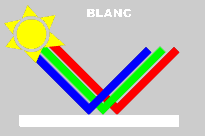
<table border="1" id="bkmrk-%C2%A0-%C2%A0-%C2%A0-si-on-fixe-du-" style="border-collapse: collapse; width: 100%; height: 859px;"><tbody><tr style="height: 152px;"><td style="width: 29.1358%; height: 152px;">![image-1634575929926.png](https://wiki.coraye.com/uploads/images/gallery/2021-10/scaled-1680-/image-1634575929926.png)

</td><td style="width: 70.8642%; height: 152px;">If we gaze at a white object, the 3 types of cones, red, green, blue, will be excited in the same way, and each will transmit a signal to the brain.  
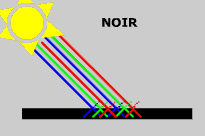
This will then combine the three pieces of information, mixing the three colors to "create" the white.</td></tr><tr style="height: 155px;"><td style="width: 29.1358%; height: 155px;">[![image-1634576434525.png](https://wiki.coraye.com/uploads/images/gallery/2021-10/scaled-1680-/image-1634576434525.png)](https://wiki.coraye.com/uploads/images/gallery/2021-10/image-1634576434525.png)

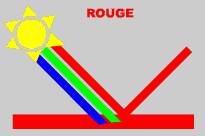
</td><td style="width: 70.8642%; height: 155px;">For black, the matter absorbs all the frequencies of the visible spectrum and therefore none of the cones will be excited and the absence of information will "create" the black.</td></tr><tr style="height: 155px;"><td style="width: 29.1358%; height: 155px;">[![image-1634576455766.png](https://wiki.coraye.com/uploads/images/gallery/2021-10/scaled-1680-/image-1634576455766.png)](https://wiki.coraye.com/uploads/images/gallery/2021-10/image-1634576455766.png)

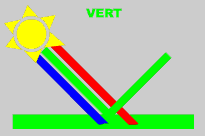
</td><td style="width: 70.8642%; height: 155px;">For red, the brain will receive a signal from the red cones, but not from the blues and greens.</td></tr><tr style="height: 155px;"><td style="width: 29.1358%; height: 155px;">[![image-1634576470378.png](https://wiki.coraye.com/uploads/images/gallery/2021-10/scaled-1680-/image-1634576470378.png)](https://wiki.coraye.com/uploads/images/gallery/2021-10/image-1634576470378.png)

</td><td style="width: 70.8642%; height: 155px;">For green, the brain will receive a signal from the green cones, but not the blues and reds.</td></tr><tr style="height: 155px;"><td style="width: 29.1358%; height: 155px;">[![image-1634576498800.png](https://wiki.coraye.com/uploads/images/gallery/2021-10/scaled-1680-/image-1634576498800.png)](https://wiki.coraye.com/uploads/images/gallery/2021-10/image-1634576498800.png)

</td><td style="width: 70.8642%; height: 155px;">For blue, the brain will receive a signal from the blue cones, but not from the greens and reds.</td></tr><tr style="height: 29px;"><td style="width: 29.1358%; height: 29px;">[![image-1634576521314.png](https://wiki.coraye.com/uploads/images/gallery/2021-10/scaled-1680-/image-1634576521314.png)](https://wiki.coraye.com/uploads/images/gallery/2021-10/image-1634576521314.png)

</td><td style="width: 70.8642%; height: 29px;">For yellow, the brain will receive a signal of equal intensity from the green and red cones, but not the blue ones.</td></tr><tr style="height: 29px;"><td style="width: 29.1358%; height: 29px;">[![image-1634576538667.png](https://wiki.coraye.com/uploads/images/gallery/2021-10/scaled-1680-/image-1634576538667.png)](https://wiki.coraye.com/uploads/images/gallery/2021-10/image-1634576538667.png)

</td><td style="width: 70.8642%; height: 29px;">For Magenta, the brain will receive a signal of equal intensity from the blue and red cones, but not the green ones.</td></tr><tr><td style="width: 29.1358%;">[![image-1634576553691.png](https://wiki.coraye.com/uploads/images/gallery/2021-10/scaled-1680-/image-1634576553691.png)](https://wiki.coraye.com/uploads/images/gallery/2021-10/image-1634576553691.png)

</td><td style="width: 70.8642%;">For Cyan, the brain will receive a signal of equal intensity from the green and blue cones, but not the red ones.</td></tr></tbody></table>

<span style="vertical-align: inherit;">If we gaze at a colored object, the 3 types of cones, red, green, blue, will be excited in a different way, and each will transmit a signal to the brain. </span>  
<span style="vertical-align: inherit;">This will then combine the three pieces of information, mixing the three colors to "create" a color. </span>  
**<span style="vertical-align: inherit;">This color will correspond to the ratio of red, green blue, reflected by the material.</span>**

[**<span style="vertical-align: inherit;">Next&gt;</span>**](https://wiki.coraye.com/books/coraye-the-prerequisites-en/page/additive-synthesis "Additive synthesis")

# Additive synthesis

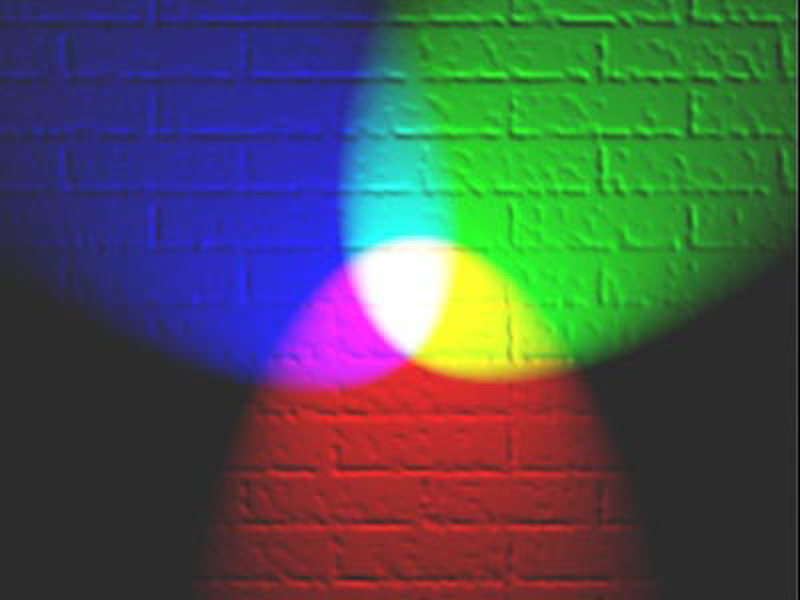
The principle of additive color synthesis consists in striving to reconstitute, for the human eye, the equivalent (appearance) of any visible color, by the addition of light from three monochromatic sources red, green, blue.

#### A little theory

Additive synthesis concerns all mixtures of colors of light origin such as spots, trichrome projectors, screens, scanners, digital cameras, etc ... and is based on the principle of colored light input.

\- In additive synthesis, red, green and blue are the primary colors

\- When we add the three components red, green, blue (RGB) to 100%, we get white

\- The absence of component (light) gives black.

\- The addition of two by two of these primary colors makes it possible to obtain the secondary colors (complementary colors)

- Cyan: green and blue light, complementary to red
- Magenta: red and blue light, complementary to green
- Yellow: green and red light, complementary to blue

[![image-1634633934531.png](https://wiki.coraye.com/uploads/images/gallery/2021-10/scaled-1680-/image-1634633934531.png)](https://wiki.coraye.com/uploads/images/gallery/2021-10/image-1634633934531.png)

#### Examples of applications

Here are two examples of the use of additive synthesis:

<table border="1" id="bkmrk-affichage-d%27un-%C3%A9cran"><tbody><tr><td class="align-center">Displaying a screen</td><td class="align-center">Light spots Red green blue</td></tr><tr><td class="align-center">[![image-1634629875259.png](https://wiki.coraye.com/uploads/images/gallery/2021-10/scaled-1680-/image-1634629875259.png)](https://wiki.coraye.com/uploads/images/gallery/2021-10/image-1634629875259.png)</td><td class="align-center">[![image-1634630149045.png](https://wiki.coraye.com/uploads/images/gallery/2021-10/scaled-1680-/image-1634630149045.png)](https://wiki.coraye.com/uploads/images/gallery/2021-10/image-1634630149045.png)</td></tr></tbody></table>

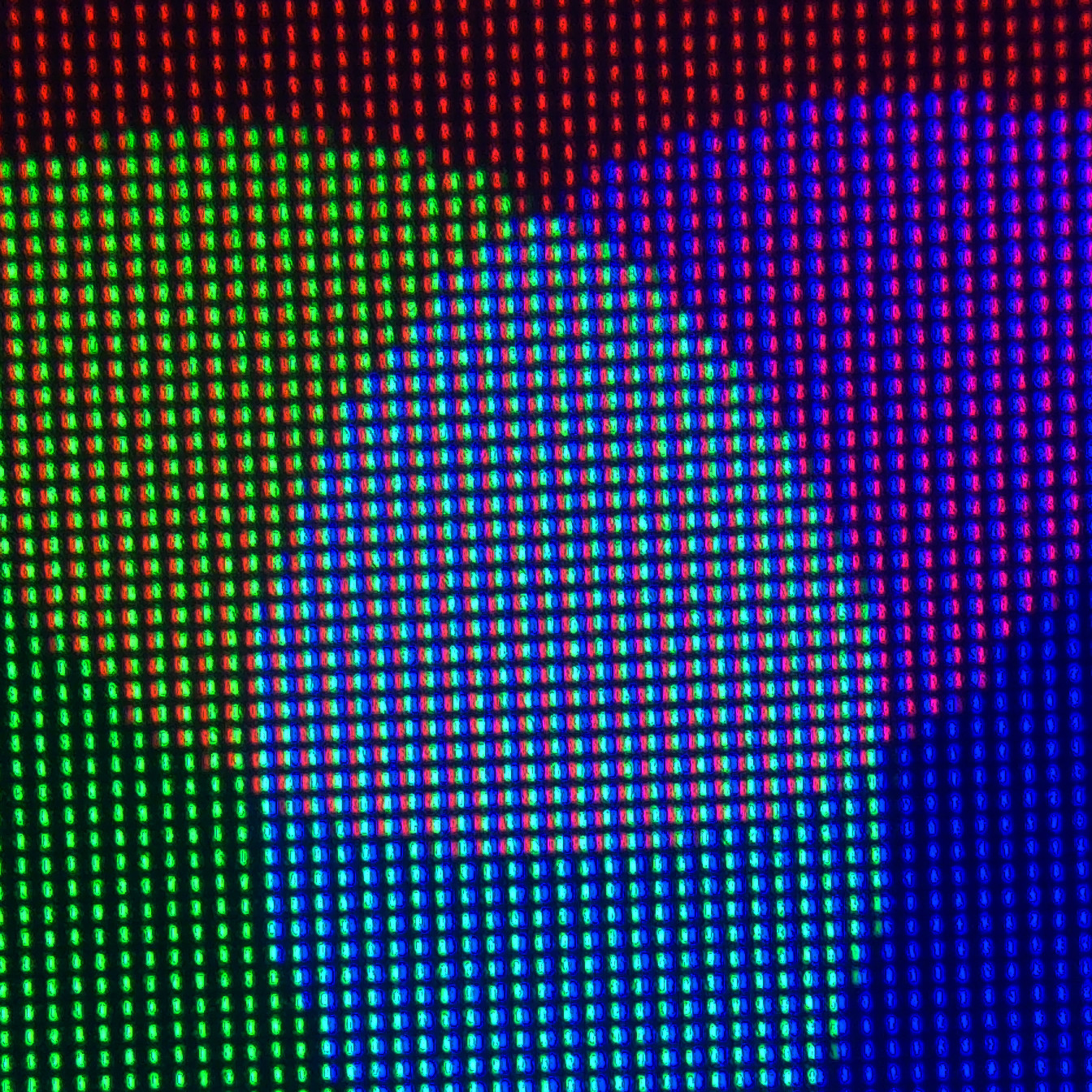
If you have the curiosity to take a magnifying glass or a thread count, and you magnify a white area of ​​your screen, you will see that the white is composed of red, green, blue pixels having a high light intensity.

#### RGB encoding

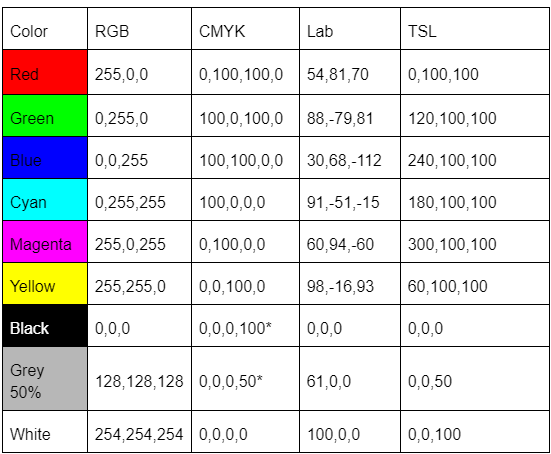
When you create an RGB color in your favorite editing software, the RGB colors are encoded from 0 to 255 or in hexadecimal from 000000 to FFFFFF (RGB color for the web)

[![RGB coding.png](https://wiki.coraye.com/uploads/images/gallery/2021-10/scaled-1680-/codage-rvb.png)](https://wiki.coraye.com/uploads/images/gallery/2021-10/codage-rvb.png)

This is because in computing, computers use binary information (0 or 1) called **bit** as a basic element and 8-bit "words" called **byte** .  
One byte is used to reproduce 256 combinations corresponding to 2 <sup>8</sup> or a series of eight 0 or 1 ranging from 00000000 to 11111111.

To code a color in RGB, red, green and blue are coded from 0 to 255 or 256 shades per primary  
The combination of the three RGB primaries represents 256x256x256 = 16,777,216 different colors.  
That is much more than the 8 million colors that the human eye is capable of dissociating.

Regarding the hexadecimal code, red, green and blue are coded on two characters from 0 to F, ie 16x16 = 256 shades.

Example:  
Red = c1, Green = 54 and blue = a2 will give the color coded in hexadecimal # c154a2 equivalent to RGB (193, 84, 162)

#### RGB Gray

An important concept in the field of calibration is the control of gray neutrality.  
Whether for monitors, cameras, scanners or printers, a well-calibrated device should be able to reproduce neutral grays.

To get neutral gray in RGB, red, green, and blue must have the same value.

For example,  
A dark gray will have an RGB value of 20, 20, 20  
A medium gray will have a value of 128, 128, 128  
A light gray will have a value of 80, 80, 80

As a reminder, RGB white will have a value of 255, 255, 255 and black 0, 0, 0.

[![image-1634639054226.png](https://wiki.coraye.com/uploads/images/gallery/2021-10/scaled-1680-/image-1634639054226.png)](https://wiki.coraye.com/uploads/images/gallery/2021-10/image-1634639054226.png)

[Next =&gt;](https://wiki.coraye.com/books/coraye-the-prerequisites-en/page/subtractive-synthesis "Subtractive synthesis")

# Subtractive synthesis

In the subtractive synthesis everything is reversed with respect to the additive system.

Cyan, magenta and yellow become the primary colors

- Red is the complementary color of cyan
- Green is the complementary color of magenta
- Blue is the complementary color of yellow

The light source is the white of the paper.  
Each deposit of dye on the paper will subtract a certain amount of light from the paper.

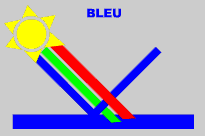
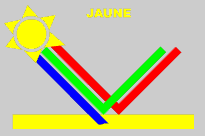
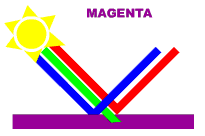
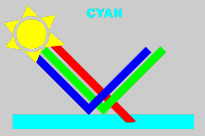
- The superposition of cyan ink and yellow ink on green.
- The superposition of magenta ink and yellow ink results in red.
- The superposition of cyan ink and magenta ink results in blue.

The darkest color in the system is the mixture of all primary inks.

[![image-1634644971427.png](https://wiki.coraye.com/uploads/images/gallery/2021-10/scaled-1680-/image-1634644971427.png)](https://wiki.coraye.com/uploads/images/gallery/2021-10/image-1634644971427.png)

By using just three dyes on a sheet of white paper, it is possible to reproduce almost all of the other colors.

Subtractive synthesis is very often associated with CMY primaries (Cyan, Magenta, Yellow).  
The mixture of the three primaries will give the darkest color of the system which should ideally be close to black.  
The absence of the three primaries obviously gives white (white of the support)

The subtractive synthesis concerns all the mixtures of colors exploiting the illumination of a support such as artistic painting, dyeing, printing inks or printers,

[![image-1634645123519.png](https://wiki.coraye.com/uploads/images/gallery/2021-10/scaled-1680-/image-1634645123519.png)](https://wiki.coraye.com/uploads/images/gallery/2021-10/image-1634645123519.png)

If in theory, the three primary colors CMY can reproduce all the intermediate colors going from white to black. In practice, the inks used in printing techniques (inkjet, offset, etc.) are not pure enough to produce theoretical black.

#### CMY or CMYK?

The maximum layering of CMY inks on the paper can only reproduce a dark brown, which is why black "N" ink has been added to these printing techniques, in order to achieve the darkest black. deep and neutral possible. Hence the CMYK color space. A CMYK file contains the 4 composite layers C, M, J, N (coded from 0 to 100%).

This system based on the CMY mixes reinforced by the color black is called the four-color process (CMYK). it is also a color space based on subtractive synthesis.

Black also has other advantages like:

- Add depth, contrast and detail
- Easier gray neutralization
- Texts printed in black only
- Reduce the amount of ink used  
    \- So drying when printing faster  
    \- So printing faster  
    \- So more profit

#### CMY Gray

An important concept in the field of calibration is the control of gray neutrality.  
A well calibrated device should be able to reproduce neutral grays.

In theory, to obtain a neutral gray in CMY, cyan, magenta and yellow must be dosed in a balanced way.

For example,  
A dark gray will have a CMY value of C80%, M80%, J80%  
A medium gray will have a value of C50%, M50%, J50%  
A light gray will have a value of C20%, M20%, J20%

This is why the control of "gray" on a printer, makes it possible to detect a colorimetric drift of this one.

#### The GCR (Gray Component Replacement)

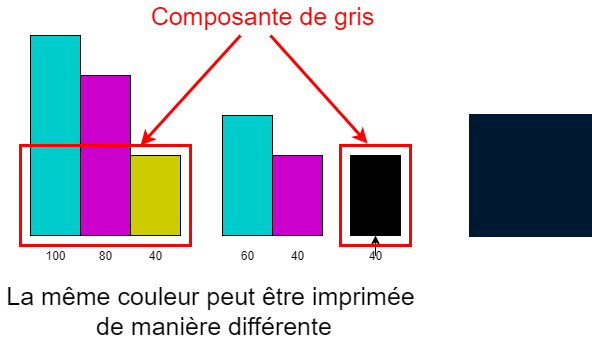
Black is taken as a full component of color.  
By definition, any trichromatic color is partly composed of a substantially equal share of Cyan, Magenta and Yellow.  
However, this substantially equal part is comparable to gray since the balance of cyan, magenta and yellow gives gray.  
We can therefore theoretically replace this part of the color, called achromatic, by black.  
In the separation, the black curve can therefore start very early and quickly gain strength.

<div drawio-diagram="899"><img src="https://wiki.coraye.com/uploads/images/drawio/2021-10/drawing-3-1634651594.png" alt=""/></div>

During CMYK separation, the color is gradually replaced by black ink.  
The darker the color, the greater the proportion of black ink.

[![image-1634652046250.png](https://wiki.coraye.com/uploads/images/gallery/2021-10/scaled-1680-/image-1634652046250.png)](https://wiki.coraye.com/uploads/images/gallery/2021-10/image-1634652046250.png)

[Next &gt;](https://wiki.coraye.com/books/coraye-the-prerequisites-en/page/standard-and-observer-illuminants "Standard and Observer illuminants")

# Standard and Observer illuminants

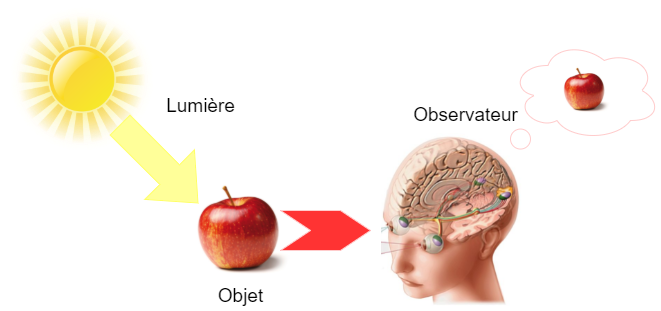
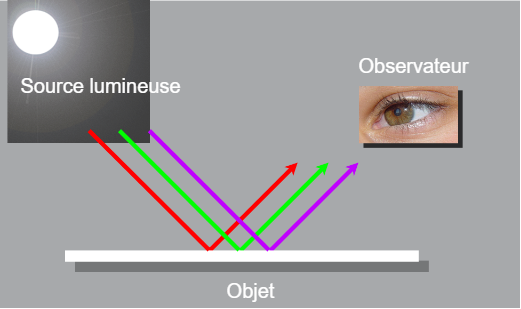
Generally speaking, the perception of the color of an object involves three elements: the light source, the object itself and the observer.

#### The spectrum of light

To fully understand how each other plays a role in perceived color, let's follow the transformation of the spectrum of light as it travels from its source to our eye  
The spectrum represents the variations in intensity of the electromagnetic waves that form light, depending on their wavelength.   
The spectrum of light emitted by a source depends on the type of source: it differs depending on whether it is the sun, a halogen lamp, a fluorecent tube, etc.

#### The light, the object and the observer

<div drawio-diagram="903"><img src="https://wiki.coraye.com/uploads/images/drawio/2021-10/drawing-3-1634657094.png" alt=""/></div>

By reflecting light, the object modifies this spectrum.  
Indeed, it absorbs part of the wavelengths of the incident light and returns the others by specular reflection (as on a mirror and diffuse reflection (in all directions), and possibly by other phenomena such as interference and diffractions   
If the object appears blue, for example, it is either because it absorbs all wavelengths, except those corresponding to blue. Or because an interference phenomenon favors the corresponding wavelengths to blue.

[![image-1634654212225.png](https://wiki.coraye.com/uploads/images/gallery/2021-10/scaled-1680-/image-1634654212225.png)](https://wiki.coraye.com/uploads/images/gallery/2021-10/image-1634654212225.png)

### Color varies depending on illuminant

##### The color of an object depends on the light shining on it.  
The object diffuses certain colors that it receives.  
It absorbs others and does not send them back.  
This is due to the nature of the objects or our environment.

#### Color perception (Observer)

The perception of colors varies with  
• The observation distance:  
• the distance blurs the colors, the proximity revives the colors

#### Standard illuminants

- CIE Illuminant A is used to represent the typical light of a  
    tungsten filament from a household bulb
- the illuminant TL84 symbolizes fluorescent lamps in shop windows
- Illuminants B and C are daylight simulators B: 4874 KC: 6774 K
- The Illuminant E is a radiator with equal energy
- Illuminant D (D50, D55, D65, etc.) Standardized daylight
- F series are fluorescent lamps

[![image-1634659997370.png](https://wiki.coraye.com/uploads/images/gallery/2021-10/scaled-1680-/image-1634659997370.png)](https://wiki.coraye.com/uploads/images/gallery/2021-10/image-1634659997370.png)

Most businesses these days have color control booths, also known as light booths.  
These booths allow color control of samples in a neutral and controlled environment.   
In fact, in order to establish a certain harmony in the methods of color control, the CIE recommends in particular the use of standardized light sources, called illuminants, on a uniform background:

The use of several illuminants makes it possible in particular to identify the presence of metameric samples. This is because two samples of a similar color under one lighting (for example daylight D65) may appear different in color under another lighting (for example bulb A).  
  
The use of light booths is a real advance in color control.  
However, the observer element remains an uncontrolled subjective parameter.  
Indeed, as explained previously, the observer captures, analyzes and processes the received signal.  
However, it sometimes happens that our colorful feeling is distorted by the surroundings.   
Thus, the existence of an optical illusion testifies to an erroneous visual perception and the interpretation of it by the brain can sometimes be altered.  
This is why, to reduce the impact of such phenomena, certain good practices should be observed when using light booths, such as a uniform background.  
The color illusions are very numerous and very impressive.  
These are the background colors that will influence our perception.

[![image-1634659642365.png](https://wiki.coraye.com/uploads/images/gallery/2021-10/scaled-1680-/image-1634659642365.png)](https://wiki.coraye.com/uploads/images/gallery/2021-10/image-1634659642365.png)

#### In conclusion

The interpretation of the color depends on parameters such as:

1. The type of light source
2. Light intensity
3. From the viewing angle
4. Of the environment
5. From the observer
6. Observation distance

#### To master the color, you must first master the light

[Next =&gt;](https://wiki.coraye.com/books/coraye-the-prerequisites-en/page/independent-color-modes-lab-lch-xyz "Independent color modes: Lab, Lch, XYZ")

# Independent color modes: Lab, Lch, XYZ

##### There are several possibilities to code the color

We saw previously the RGB and the CMYK which are coded according to scales going:  
From 0 to 255 for the RGB (8 bits)  
From 0 to 100 for the CMYK (% of ink)  
From 000000 to FFFFFF The hexadecimal for the Web (RGB)

There are other ways to code the color such as:  
The TSL (Lch in English)  
The Lab  
The XYZ

**The advantage of Lab, HSL and XYZ modes is that they are based on the perception of the human eye and that the description of a color is precise and unlike RGB and CMYK spaces.**

#### HSL mode (Hue, Saturation, Light)

In French: Lch (Lightness, Chroma, Hue)

The TSL model is a perceptual colorimetric model because it closely approximates the physiological perception of color by the human eye.  
In this system, the colors are always characterized by three dimensions but which have a completely different meaning than in the RGB model, since they represent here hue, saturation and luminosity.  
The TSL model is generally represented using two inverted cones placed one above the other (figure below).

- **The hue** which corresponds to the perception of color is measured on a circular scale (Newton's chromaticity circle) by an angle of 0 ° to 360 °.
- **Saturation is a** measure of the degree of purity of a color, that is, the amount of gray added to the color. It is represented by the radius of a circular section of the cone and varies from 0% (corresponding gray level) to 100% (pure or saturated color).
- **Brightness** represents the degree to which a color is brightened or darkened.  
    It is defined according to a linear scale ranging from 0% (black) to 100% (white) through all gray levels.

<u>[![image-1635069770301.png](https://wiki.coraye.com/uploads/images/gallery/2021-10/scaled-1680-/image-1635069770301.png)](https://wiki.coraye.com/uploads/images/gallery/2021-10/image-1635069770301.png)</u>

#### Lab mode

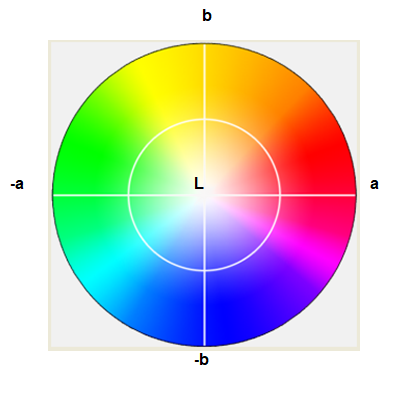
In 1976, the CIE (International Commission on Illumination) developed the **La \* b \*** colorimetric model (also known as *CIELab* ), in which a color was identified by three values:

- **L** , the light, expressed as a percentage represents the gray axis (0% for black to 100% for white)
- **a** and **b** two color ranges respectively going from green to red and from blue to yellow with values ​​ranging from -127 to +127.

<div drawio-diagram="920"><img src="https://wiki.coraye.com/uploads/images/drawio/2021-10/drawing-3-1635092103.png" alt=""/></div>

*Lab* mode thus covers the entire spectrum visible to the human eye and represents it in a uniform manner.  
It therefore makes it possible to describe all the visible colors independently of any graphic technology.

This way it understands all the RGB and CMYK colors, which is why software such as PhotoShop uses this mode to switch from one representation model to another.

The CIE models are not intuitive, however **using them ensures that a color created according to these models will be seen the same by everyone!**

Lab mode is the bridge between RGB and CMYK modes.  
Used in color management and more exactly in ICC profiles.

[![image-1635089055559.png](https://wiki.coraye.com/uploads/images/gallery/2021-10/scaled-1680-/image-1635089055559.png)](https://wiki.coraye.com/uploads/images/gallery/2021-10/image-1635089055559.png)

#### The CIE XYZ model

The CIE XYZ model (also called the CIE 1931 model) is the first colorimetric model created by the CIE in 1931. Produced from a series of experiments on the perception of colors by the human eye, this model serves as a reference for define other models. The three components X, Y and Z of the model represent respectively hue, luminance (light intensity weighted by the spectral sensitivity of the eye) and saturation. These three values, called tristimulus values, which are functions of the light, object, observer triplet, are obtained by integrating into the visible spectrum the product of the reflectance of the object illuminated by an illuminant by the spectral sensitivity of the human eye ( figure below).

SPECTRAL SENSITIVITY OF THE HUMAN EYE FOR A "STANDARD" OBSERVER

![](https://e-cours.univ-paris1.fr/modules/uved/envcal/html/compositions-colorees/representations-couleur/modeles-ref-cie/ressources/images/fonctions.jpg)

![X = k \ int_ {400nm} ^ {800nm} I (\ lambda) \ times R (\ lambda) \ times x (\ lambda) .d \ lambda](https://e-cours.univ-paris1.fr/modules/uved/envcal/html/compositions-colorees/representations-couleur/modeles-ref-cie/eq_tex_compositions-colorees/equation2.png)  
![Y = k \ int_ {400nm} ^ {800nm} I (\ lambda) \ times R (\ lambda) \ times y (\ lambda) .d \ lambda](https://e-cours.univ-paris1.fr/modules/uved/envcal/html/compositions-colorees/representations-couleur/modeles-ref-cie/eq_tex_compositions-colorees/equation3.png)  
![Z = k \ int_ {400nm} ^ {800nm} I (\ lambda) \ times R (\ lambda) \ times z (\ lambda) .d \ lambda](https://e-cours.univ-paris1.fr/modules/uved/envcal/html/compositions-colorees/representations-couleur/modeles-ref-cie/eq_tex_compositions-colorees/equation4.png)  
With  
![k = \ frac {100} {\ int_ {400nm} ^ {800nm} l (\ lambda) \ times y (\ lambda) .d \ lambda}](https://e-cours.univ-paris1.fr/modules/uved/envcal/html/compositions-colorees/representations-couleur/modeles-ref-cie/eq_tex_compositions-colorees/equation5.png)  
I: spectral density of the illuminant  
R: reflectance of the object  
x, y and z: color equivalence functions

#### Color coding

<div drawio-diagram="998"><img src="https://wiki.coraye.com/uploads/images/drawio/2021-12/drawing-3-1638435317.png" alt=""/></div>

[Next =&gt;](https://wiki.coraye.com/books/coraye-the-prerequisites-en/page/icc-profiles "ICC profiles")

# ICC Profiles

An **ICC ( [International Color Consortium](https://fr.wikipedia.org/wiki/International_Color_Consortium "International Color Consortium") ) profile** is a file with an .icc or .icm extension.

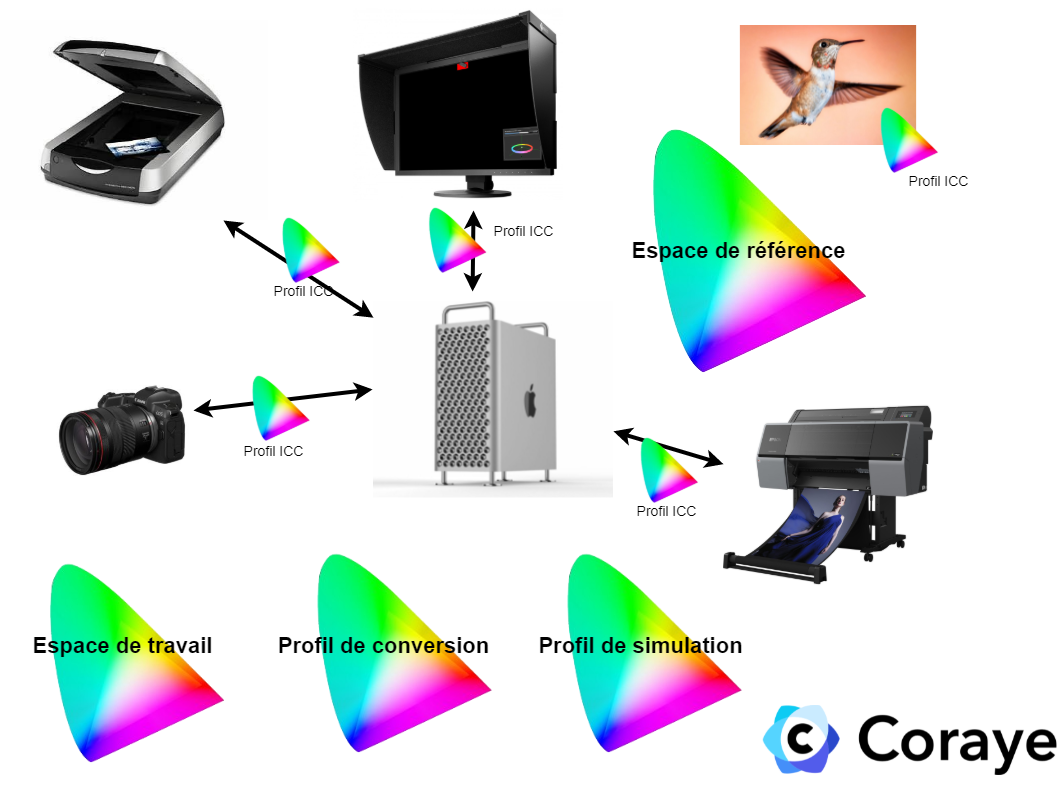
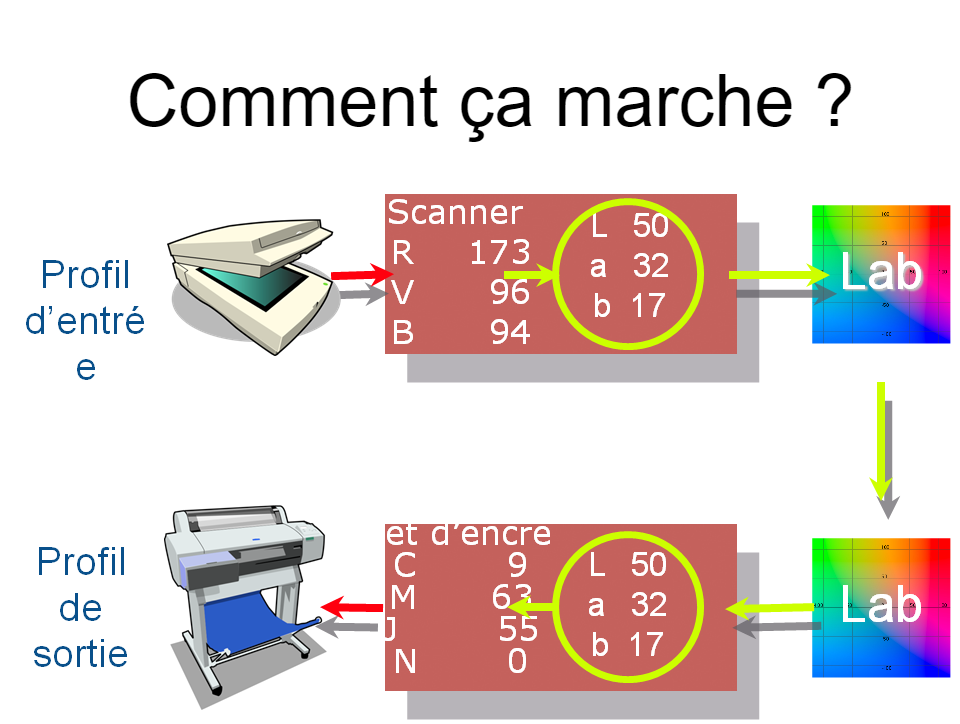
This file contains the data to convert colors from a source color space (CMYK, RGB and usually linked to a device) to an independent color space (L \* a \* b \* or XYZ, standardized spaces covering the spectrum visible by the human eye).  
It relates the coordinates of colors in the source color space to the coordinates of colors in the independent color space.

#### How it works

The icc profile is, therefore, a color conversion table, used by computer operating systems to correct the colors of different peripherals, but also in design software, RIPs, etc.

<div drawio-diagram="929"><img src="https://wiki.coraye.com/uploads/images/drawio/2021-10/drawing-3-1635602879.png" alt=""/></div>

An ICC profile can *characterize* :

- a screen, a scanner, a digital camera. In this case, it will be an RGB profile;
- a printer, an offset press. In this case, it will usually be a CMYK profile.

#### <span class="mw-headline" id="bkmrk-applications-0">Applications</span>

The ICC profile allows you to know which colors are reached by the device and how it is possible:

- optimize the colorimetric rendering of the device (screen calibration, scanner calibration, paper profiles for printers, etc.)
- to calculate and visualize its gamut;
- to simulate the colorimetric rendering of the device on another for a contractual proof. A very common case is the simulation of a press on a plotter (BAT test, soft proofing)
- to harmonize the colorimetric renderings of a graphic chain between scanner, screen, plotter and press.
- convert images to switch from one color space to another (for example from RGB to CMYK)

ICC profiles have very specific functions.  
For example, a screen characterization profile should not be used to convert images.  
Similarly, the profile used for "calibration" of a printer's papers is not used to simulate the colors printed on a screen.

<p class="callout success">For more information, see the site: [ICC Profile - Wikipedia](https://fr.wikipedia.org/wiki/Profil_ICC "ICC Profile - Wikipedia")</p>

#### Location of profiles on your computers

Mac OS X  
\- Library&gt; ColorSync&gt; Profiles  
\- “User”&gt; Library&gt; ColorSync&gt; Profiles

Windows  
\- Windows&gt; System32&gt; Spool&gt; Drivers&gt; Color

#### How to create ICC profiles

Characterizing a device or media involves measuring a range of color patches.

**For a printer** , we characterize a medium (paper, vinyl, tarpaulin, fabrics, etc.).  
This consists in printing a test chart on the support that one wishes to characterize, then it is measured with a spectrophotometer.

**For a scanner** , a reference range of the IT8.7 / 2 type is scanned, then the colors of the image thus captured are compared with a text file containing the reference Lab values ​​of the colors in the range.

**For a** digital **camera** , a reference range of Colorchecker type is photographed, then the colors of the image thus captured are compared with a text file containing the Lab values ​​of the colors in the Colorchecker range.

<table border="1" id="bkmrk-imprimante-scanner-a"><tbody><tr><td class="align-center">Printer</td><td class="align-center">To scan</td><td class="align-center">Digital camera</td></tr><tr><td class="align-center">![I1Pro ECI2002R 3.png](https://wiki.coraye.com/uploads/images/gallery/2021-08/scaled-1680-/i1pro-eci2002r-3.png)</td><td class="align-center">[![image-1635596681960.png](https://wiki.coraye.com/uploads/images/gallery/2021-10/scaled-1680-/image-1635596681960.png)](https://wiki.coraye.com/uploads/images/gallery/2021-10/image-1635596681960.png)

</td><td class="align-center">[![image-1635596659512.png](https://wiki.coraye.com/uploads/images/gallery/2021-10/scaled-1680-/image-1635596659512.png)](https://wiki.coraye.com/uploads/images/gallery/2021-10/image-1635596659512.png)

</td></tr></tbody></table>

The icc profile thus produced contains the reference values ​​and the measured values ​​which will be used subsequently by the applications or the operating systems.

#### [![image-1635093428389.png](https://wiki.coraye.com/uploads/images/gallery/2021-10/scaled-1680-/image-1635093428389.png)](https://wiki.coraye.com/uploads/images/gallery/2021-10/image-1635093428389.png)

#### Coraye and ICC profiles

Coraye's Print Profiler RGB and CMYK modules allow you to create ICC profiles to allow your printing systems to reproduce colors faithfully depending on the media (paper, textile, vinyl, etc.).  
It is also possible with these two modules to create simulation profiles to anticipate the results you will get when printing.

<p class="callout success">To find out more, see the chapter: [Creating a profile from a standard test pattern](https://wiki.coraye.com/books/coraye-manual-en/page/create-a-profile-from-a-standard-test-pattern "Create a profile from a standard test pattern")</p>

Coraye also uses profiles to convert measured colors, color tables, etc.

<p class="callout success">For more information, see chapter: [Color converter](https://wiki.coraye.com/books/coraye-manual-en/page/color-converter-e7b "Color converter")</p>

<p class="callout success">For more information, see the chapter: [Converting color tables to make them printable](https://wiki.coraye.com/books/coraye-manual-en/page/convert-color-tables-to-make-them-printable "Convert color tables to make them printable")</p>

[Next =&gt;](https://wiki.coraye.com/books/coraye-the-prerequisites-en/page/the-gamut "The Gamut")

# The Gamut

##### The gamut represents the 3-dimensional modeling of the colors of an ICC profile or an image.

Usually this graphic representation is displayed in a 3D Lab space.

In the example below, we can compare the gamut of the ICC profile of an Epson SC-P7000 printer with the gamut of an image.

[![image-1635600650489.png](https://wiki.coraye.com/uploads/images/gallery/2021-10/scaled-1680-/image-1635600650489.png)](https://wiki.coraye.com/uploads/images/gallery/2021-10/image-1635600650489.png)
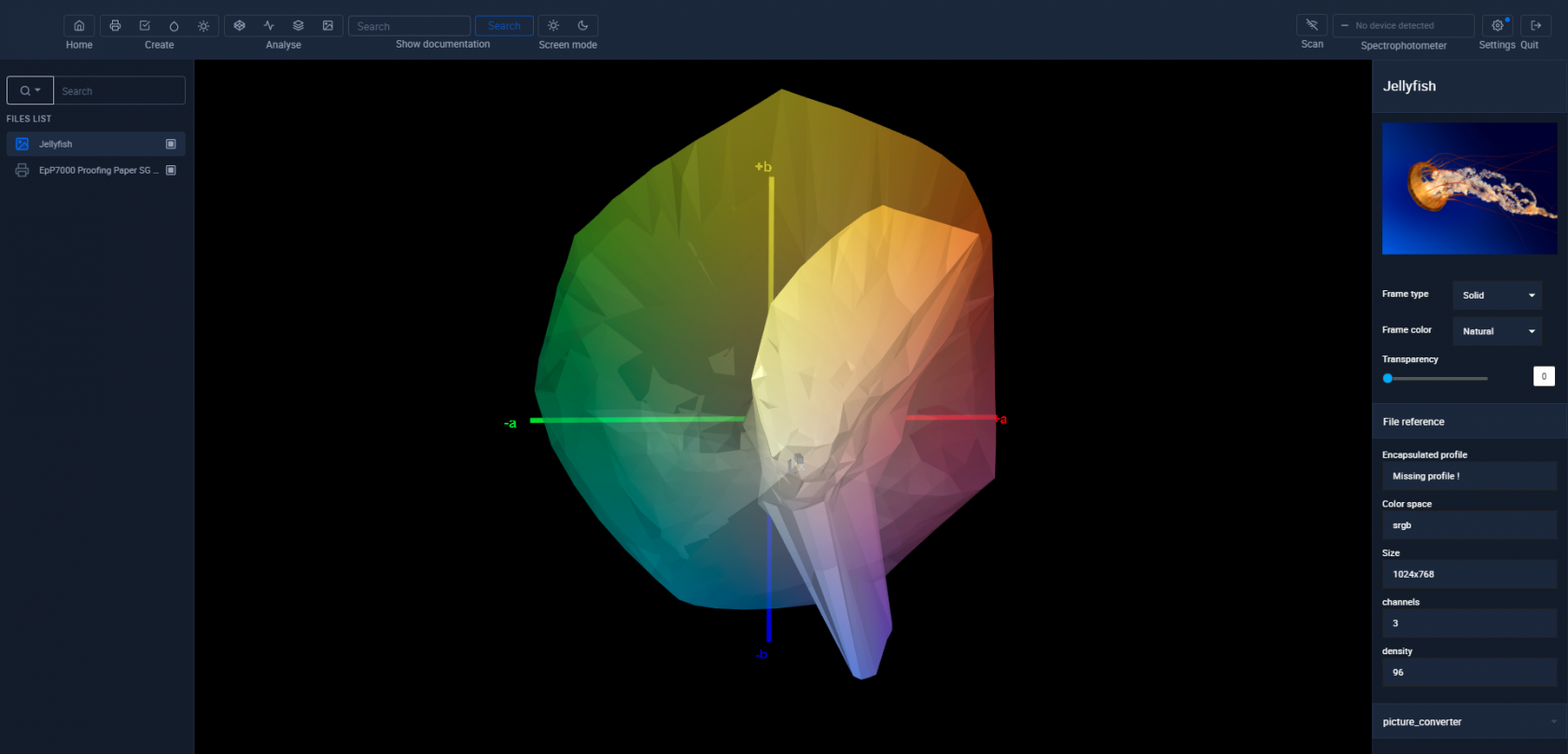
In this example we can see by superimposing the two gamuts, that the saturated blue of the jellyfish image comes out of the reproducible color gamut of the printer.

---

---

As we saw in the chapter on ICC profiles, the ICC profile is made from the measurement of a range of color patches.  
Thanks to the Gamut Viewer, we can compare the measured colors with the ICC profile generated from these measurements.

[![image-1635601620508.png](https://wiki.coraye.com/uploads/images/gallery/2021-10/scaled-1680-/image-1635601620508.png)](https://wiki.coraye.com/uploads/images/gallery/2021-10/image-1635601620508.png)
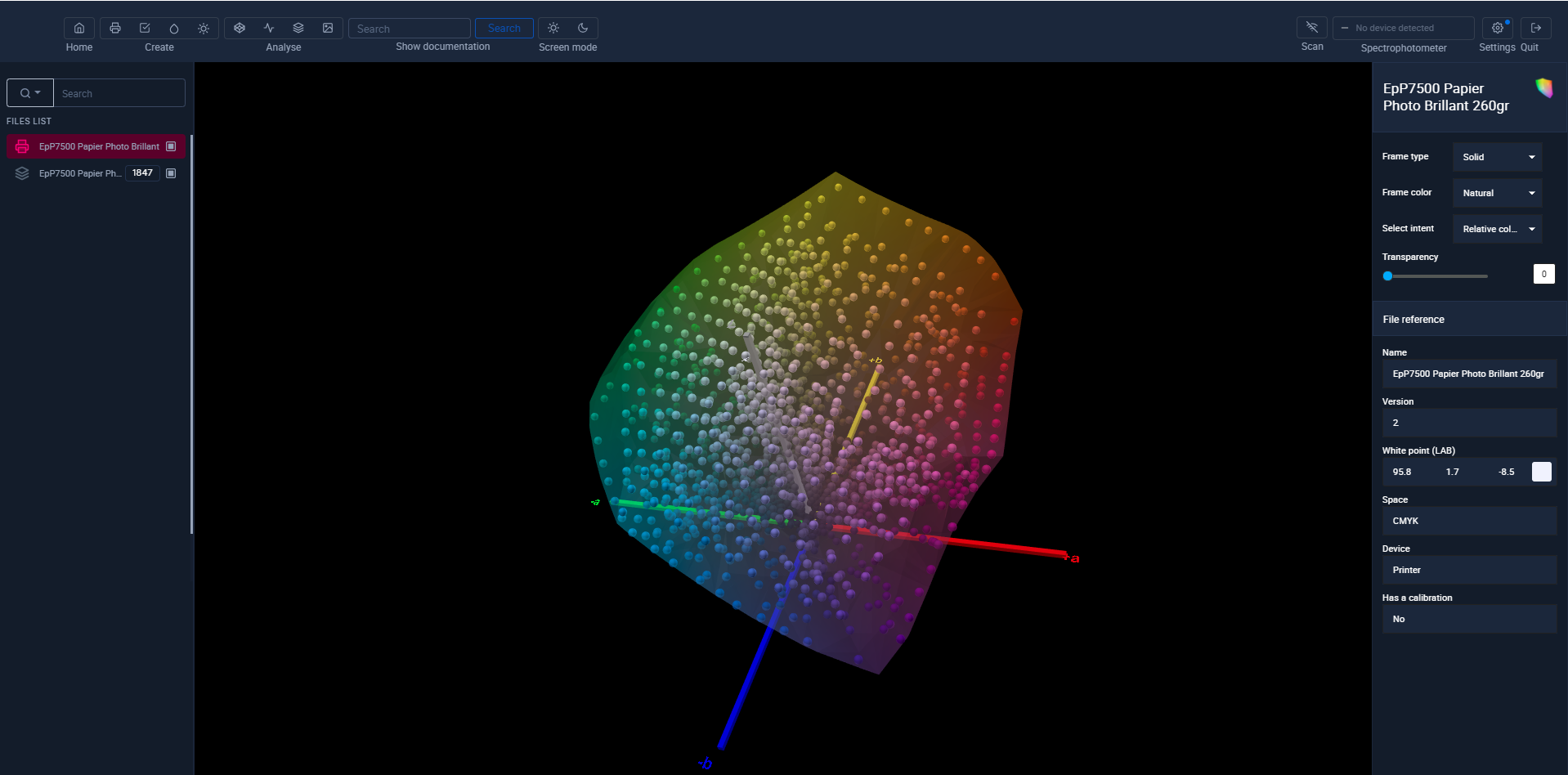
The choice of the range and the number of patches is decisive when creating the ICC profile.

<p class="callout success">To find out more, see the chapter: [Gamut Viewer](https://wiki.coraye.com/books/coraye-manual-en/page/gamut-viewer-2b2 "Gamut Viewer") in the Coraye manual</p>

#### Non-reproducible colors

In the example below we have displayed in the Gamut Viewer the profile of a printer, that of an image and a saturated color.  
As we have seen previously, we can see that some colors of the image cannot be reproduced faithfully as well as the color Yellow.

[![Gamut flower.png](https://wiki.coraye.com/uploads/images/gallery/2021-11/scaled-1680-/gamut-fleur.png)](https://wiki.coraye.com/uploads/images/gallery/2021-11/gamut-fleur.png)
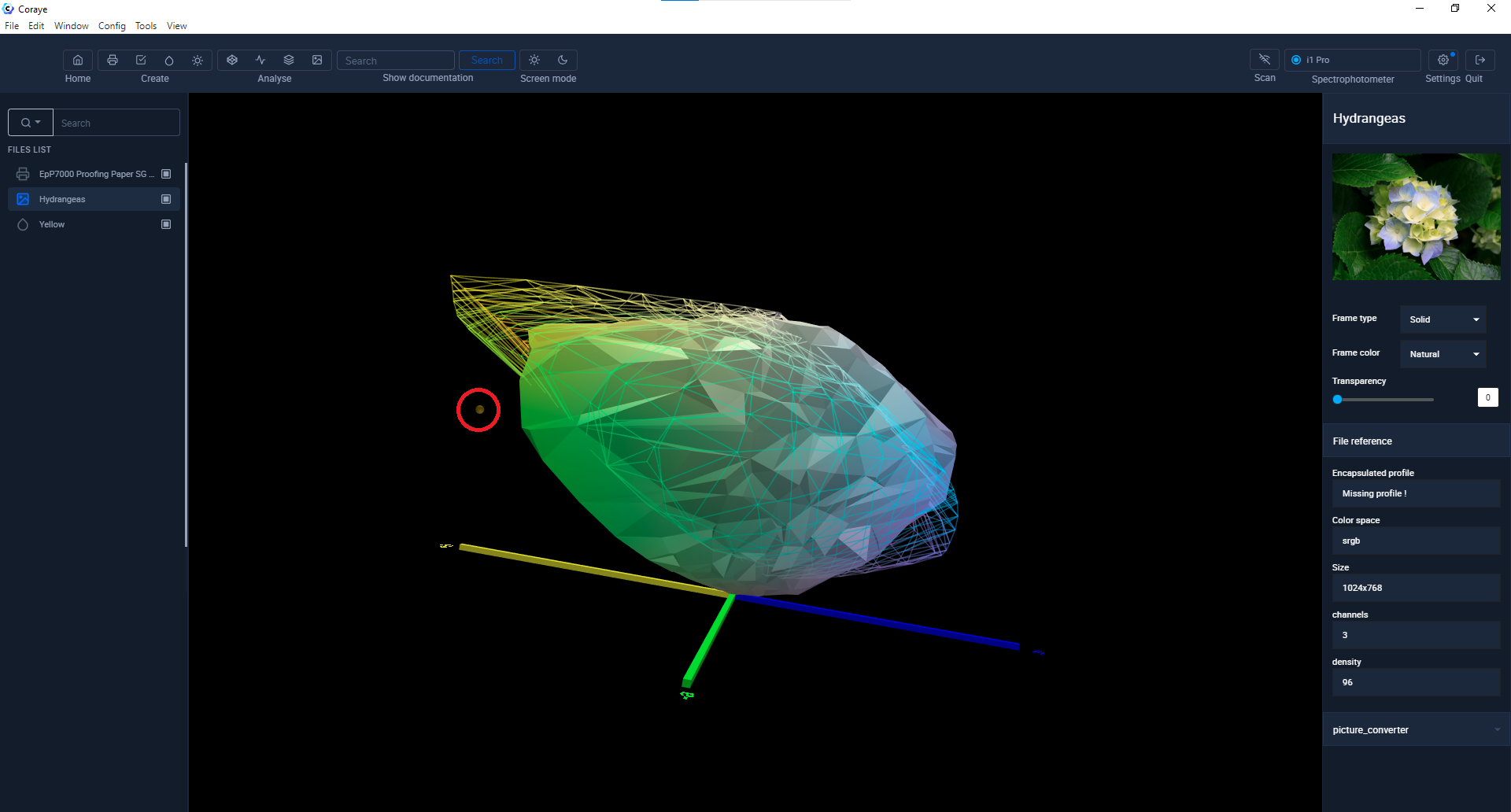
The Gamut Viewer tool is an educational tool that allows you to check color reproducibility without the need to print.

[Next =&gt;](https://wiki.coraye.com/books/coraye-the-prerequisites-en/page/reference-color-spaces "Reference color spaces")

# Reference color spaces

As in any field, when it comes to calibration, we must always perform calibrations against a reference or a standard.  
The graphic chain is no exception to the rule. This is why it is necessary to use reference color spaces to standardize the colorimetric renderings.

The problem is that different devices cannot capture, display or print the same colors.

To remedy this, reference color spaces have been defined according to the destination of the images to be reproduced.

<table border="1" id="bkmrk-le-web-l%27impression-"><tbody><tr><td class="align-center">The web - office screen</td><td class="align-center">Digital printing</td></tr><tr><td class="align-center">[![image-1635668063988.png](https://wiki.coraye.com/uploads/images/gallery/2021-10/scaled-1680-/image-1635668063988.png)](https://wiki.coraye.com/uploads/images/gallery/2021-10/image-1635668063988.png)

</td><td class="align-center">[![image-1635608002029.png](https://wiki.coraye.com/uploads/images/gallery/2021-10/scaled-1680-/image-1635608002029.png)](https://wiki.coraye.com/uploads/images/gallery/2021-10/image-1635608002029.png)</td></tr><tr><td class="align-center">Industrial printing</td><td class="align-center">The video</td></tr><tr><td class="align-center">[![image-1635608127995.png](https://wiki.coraye.com/uploads/images/gallery/2021-10/scaled-1680-/image-1635608127995.png)](https://wiki.coraye.com/uploads/images/gallery/2021-10/image-1635608127995.png)</td><td class="align-center">[![image-1635608257541.png](https://wiki.coraye.com/uploads/images/gallery/2021-10/scaled-1680-/image-1635608257541.png)](https://wiki.coraye.com/uploads/images/gallery/2021-10/image-1635608257541.png)</td></tr><tr><td class="align-center">Silver photo print</td><td class="align-center">APN</td></tr><tr><td class="align-center">[![image-1635667554473.png](https://wiki.coraye.com/uploads/images/gallery/2021-10/scaled-1680-/image-1635667554473.png)](https://wiki.coraye.com/uploads/images/gallery/2021-10/image-1635667554473.png)

</td><td class="align-center">[![image-1635667844700.png](https://wiki.coraye.com/uploads/images/gallery/2021-10/scaled-1680-/image-1635667844700.png)](https://wiki.coraye.com/uploads/images/gallery/2021-10/image-1635667844700.png)

</td></tr><tr><td class="align-center">Smart phone &amp; tablet

</td><td class="align-center"></td></tr><tr><td class="align-center">[![image-1636127918880.png](https://wiki.coraye.com/uploads/images/gallery/2021-11/scaled-1680-/image-1636127918880.png)](https://wiki.coraye.com/uploads/images/gallery/2021-11/image-1636127918880.png)

</td><td class="align-center"></td></tr></tbody></table>

---

#### The most common reference profiles:

##### RGB space:

\- [**sRGB Color Space Profile.icc**](https://fr.wikipedia.org/wiki/SRGB "en.wikipedia / sRGB") : Generic color space for office automation screens  
Color space used to process images intended for websites on the web, silver photo prints and images for "general public" use.

\- [**AdobeRGB1998.icc**](https://fr.wikipedia.org/wiki/Adobe_RGB "en.wikipedia / AdobeRGB1998") : Color space created by Adobe in 1998. It was designed for graphic designers whose screen work is intended for printing.

\- **Display P3** : Color space for office screens larger than sRGB (new generation Apple screen, tablet and smart phone)

**[ProPhoto.icc](https://en.wikipedia.org/wiki/ProPhoto_RGB_color_space "en.wikipedia / ProPhoto RGB")** : Color space created by Kodak in 1980 and based on the set of colors that the eye is able to see.  
The downside of this model is that display and printing devices are far unable to reproduce the colors of its gamut.  
This color space is generally used for processing RAW images from digital cameras.

##### Video :

**[REC709](https://fr.wikipedia.org/wiki/Rec._709 "REC709")** : Recommendation Rec. 709, entitled "  *Parameter values ​​of HDTV standards for production*

*and international program exchange* ”, is an audiovisual industry standard for [high definition](https://fr.wikipedia.org/wiki/Haute_d%C3%A9finition "High Definition") television (HDTV).

[**REC2020**](https://fr.wikipedia.org/wiki/Rec._2020 "REC2020") : Recommendation Rec. 2020, is an audiovisual industry standard for [ ultra high definition](https://fr.wikipedia.org/wiki/T%C3%A9l%C3%A9vision_%C3%A0_ultra-haute_d%C3%A9finition "Ultra-high definition television") (UHDTV).

**[DCI P3](https://fr.wikipedia.org/wiki/DCI-P3 "DCI P3")** : DCI-P3 has a wider[ gamut](https://fr.wikipedia.org/wiki/Gamut "Gamut") than [ Rec 709](https://fr.wikipedia.org/wiki/Rec._709 "Rec.  709") designed for [Movies](https://fr.wikipedia.org/wiki/T%C3%A9l%C3%A9viseur "TV") , taken up by [ sRGB](https://fr.wikipedia.org/wiki/SRGB "SRGB") for [ computer screens](https://fr.wikipedia.org/wiki/%C3%89cran_d%27ordinateur "Computer screen") . It constitutes a step for access to [ Rec 2020](https://fr.wikipedia.org/wiki/Rec._2020 "Rec.  2020") , providing for a larger color space<sup class="reference" id="bkmrk-1">[ 1](https://fr.wikipedia.org/wiki/DCI-P3#cite_note-1)</sup> . sRGB reproduces approximately 36% of all visible colors; DCI-P3, approximately 45%.

##### CMYK space:

Generally, the CMYK reference profiles are taken from the standards used in the field of graphic arts.  
We will tackle this subject in a chapter dedicated to Fogra and IDEAlliance standards.

**[PrintWide2020](https://idealliance.org/idealliance-releases-new-printwide-color-profile-and-guide-to-support-new-print-technologies/ "PrintWide2020")** ; PrintWide is a very wide gamut CMYK reference space designed to encompass the gamut of  
all inks or dyes in all known color printing systems.  
Although the dataset has only four channels (CMYK), its gamut includes the effect of typical "wide gamut" inks such as OGV (Orange, Green and Purple) or RGB (Red Green and Blue) often. used in inkjet, flexo or offset printing.

#### Representation of Gamuts

In order to illustrate the differences between reference spaces, we are going to display a few of them in the gamut viewer.  
Remember that the greater the volume of the gamut, the greater the number of colors that we will be able to reproduce.

From the smallest to the largest gamut:  
\- Isocoated\_v2\_eci.icc (CMYK offset printer) (green)  
\- sRGB and REC 709 (web, HDTV &amp; general public) (yellow)  
\- DCI P3 and Display P3 (green)  
\- Adobe RGB 1998 ( light red)  
\- REC 2020 (UHDTV) (dark red)

[![image-1636132069442.png](https://wiki.coraye.com/uploads/images/gallery/2021-11/scaled-1680-/image-1636132069442.png)](https://wiki.coraye.com/uploads/images/gallery/2021-11/image-1636132069442.png)

---

#### How to optimize the colors of your prints?

Your printer is capable of reproducing a number of colors.  
This will depend on its technology, the inks used and the media for printing.  
  
If you want to optimize the colors of your prints, choose the color space that will allow you to do so.  
  
Let's take an example:  
I want to print images on an Epson SC-P7000 printer that uses C, M, J, N, lc, lm, lg, llg, Orange and Green inks.

[![image-1635608002029.png](https://wiki.coraye.com/uploads/images/gallery/2021-10/scaled-1680-/image-1635608002029.png)Epson SC-P7000](https://wiki.coraye.com/uploads/images/gallery/2021-10/image-1635608002029.png)

Let's compare the colors that the printer is able to reproduce with the sRGB.icc reference space  
As we can see, it would be a shame in this case to convert the images to sRGB.icc for printing, because the sRGB. icc is very limited in the reproduction of "blue-green".

[![image-1636560660938.png](https://wiki.coraye.com/uploads/images/gallery/2021-11/scaled-1680-/image-1636560660938.png)Epson P7000 vs sRGB profile](https://wiki.coraye.com/uploads/images/gallery/2021-11/image-1636560660938.png)

Now let's compare the Adobe RGB 1998.icc color space with this same profile of the Epson SC-P7000 (CMYK + Orange and Green inks)

Adobe RGB 1998.icc having a larger gamut (volume) you will be able to reproduce prints with more saturated "blue-green".   
This is very interesting for the reproduction of photos of landscapes (sky and azure blue sea for example).

[![image-1636560559521.png](https://wiki.coraye.com/uploads/images/gallery/2021-11/scaled-1680-/image-1636560559521.png)](https://wiki.coraye.com/uploads/images/gallery/2021-11/image-1636560559521.png)[Profile Epson P7000 vs Adobe RGB 1998.icc](https://wiki.coraye.com/uploads/images/gallery/2021-11/image-1636560559521.png)

The new CMYK PrintWide2020.icc reference profile optimizes prints made on printers with extended gamuts using CMYK, Orange, Green and Violet inks.

[![image-1637079119892.png](https://wiki.coraye.com/uploads/images/gallery/2021-11/scaled-1680-/image-1637079119892.png)Profile Epson P7000 vs PrintWide2020.icc](https://wiki.coraye.com/uploads/images/gallery/2021-11/image-1637079119892.png)

Adobe RGB 1998 space vs sRGB [![image-1636212548254.png](https://wiki.coraye.com/uploads/images/gallery/2021-11/scaled-1680-/image-1636212548254.png)Adobe RGB 1998 space vs sRGB](https://wiki.coraye.com/uploads/images/gallery/2021-11/image-1636212548254.png)

#### Conclusion

To optimize the reproduction of your images, choose a color space suited to the reproduction capabilities of your devices.

[Next =&gt;](https://wiki.coraye.com/books/coraye-the-prerequisites-en/page/the-dependent-color-modes-rgb-cmyk "The dependent color modes: RGB, CMYK")

# The dependent color modes: RGB, CMYK

In the previous chapter we compared the gamut of different RGB profiles and we saw that each of them are able to reproduce more or less saturated colors.

#### RGB mode

Take for example the RGB sRGB and Adobe RGB 1998 profiles and compare them in the gamut Viewer:

We can see that the gamut of Adobe RGB 1998 is much larger than that of sRGB

[![image-1636212548254.png](https://wiki.coraye.com/uploads/images/gallery/2021-11/scaled-1680-/image-1636212548254.png)](https://wiki.coraye.com/uploads/images/gallery/2021-11/image-1636212548254.png)

Let's create a green color with the Lab values ​​80, -120, 85.  
This color is in the gamut of the Adobe RGB 1998 profile but it is not in the gamut of the sRGB.

**This means that it is possible to reproduce it in the Adobe RGB 1998 space but not in the sRGB space.**

The RGB value of this color in the Adobe RGB 1998 space is 51, 242, 0

[![Adobe RGB vs sRGB.png](https://wiki.coraye.com/uploads/images/gallery/2021-11/scaled-1680-/adobe-rgb-vs-srgb.png)](https://wiki.coraye.com/uploads/images/gallery/2021-11/adobe-rgb-vs-srgb.png)

Let's enter this value in Photoshop by indicating in the "Edit&gt; Color" settings the sRGB profile as the reference profile:

[![Adobe RGB vs sRGB 2.png](https://wiki.coraye.com/uploads/images/gallery/2021-11/scaled-1680-/adobe-rgb-vs-srgb-2.png)](https://wiki.coraye.com/uploads/images/gallery/2021-11/adobe-rgb-vs-srgb-2.png)

Let's indicate the same RGB value of the green color converted with the Adobe RGB 1998.icc profile: 51, 242, 0  
In the Photoshop color picker, the Lab value obtained with the sRGB.icc profile becomes 84, -73, 78

[![Adobe RGB vs sRGB 3.png](https://wiki.coraye.com/uploads/images/gallery/2021-11/scaled-1680-/adobe-rgb-vs-srgb-3.png)](https://wiki.coraye.com/uploads/images/gallery/2021-11/adobe-rgb-vs-srgb-3.png)

Let's compare the two Lab values ​​corresponding to the same RGB value   
In the Adobe RGB 1998 space the RGB value 51, 242, 0 gives a Lab value 80, -120, 85  
In the sRGB space the RGB value 51, 242, 0 gives a Lab value 84, -73, 78

  
[![Adobe RGB vs sRGB 4.png](https://wiki.coraye.com/uploads/images/gallery/2021-11/scaled-1680-/adobe-rgb-vs-srgb-4.png)](https://wiki.coraye.com/uploads/images/gallery/2021-11/adobe-rgb-vs-srgb-4.png)

##### So depending on the color space, the same RGB value gives a different color

Remember that the RGB values ​​encoded in 8 bits vary from 0 to 255 for Red, Green and Blue.  
We therefore have a scale of 256 values ​​distributed in relation to the volume of the profile.  
This explains why the same RGB value does not give the same color depending on the profile.

##### The RGB mode is therefore a color mode depending on its reference profile.

#### CMYK mode

For the CMYK, the values ​​Cyan, Magenta, Yellow and Black are in percentage%, ie they are coded from 0 to 100.  
We thus have a scale of values ​​distributed compared to the volume of the profile.  
This explains why the same CMYK value does not give the same color depending on the profile.  
  
Example: Cyan 20%, Magenta 75%, Yellow 10% Black 10%

In the example below, we compare the volume of one CMYK profile Isocoated\_v2\_eci.icc with another CMYK profile PSO\_Uncoated\_v3\_Fogra52.icc  
The profile Isocoated\_v2\_eci.icc (corresponding to a paper coated in offset printing) has a volume greater than that of the profile PSOuncoated\_v3\_Fogra52.icc (corresponding to uncoated paper in offset printing)  
This means that we will be able to reproduce more saturated colors on coated paper.

[![image-1636216676322.png](https://wiki.coraye.com/uploads/images/gallery/2021-11/scaled-1680-/image-1636216676322.png)](https://wiki.coraye.com/uploads/images/gallery/2021-11/image-1636216676322.png)

##### So depending on the color space, the same CMYK value gives a different color

##### CMYK mode is therefore a color mode depending on its reference profile.

#### Spot colors

Take for example the PANTONE colors  
By comparing the colors of a PANTONE Solid Coated color chart with the CMYK profile Isocoated\_v2\_eci.icc, we can see that a large number of colors are outside the gamut of the CMYK profile.

[![image-1636218091340.png](https://wiki.coraye.com/uploads/images/gallery/2021-11/scaled-1680-/image-1636218091340.png)](https://wiki.coraye.com/uploads/images/gallery/2021-11/image-1636218091340.png)

So it is not possible to communicate these colors in CMYK without modifying the color.

This is why the colors of the PANTONE digital color charts are defined in Lab (or with their spectral values).

---

<div drawio-diagram="962"><img src="https://wiki.coraye.com/uploads/images/drawio/2021-11/drawing-3-1636394991.png" alt=""/></div>

[![image-1636394084870.png](https://wiki.coraye.com/uploads/images/gallery/2021-11/scaled-1680-/image-1636394084870.png)](https://wiki.coraye.com/uploads/images/gallery/2021-11/image-1636394084870.png)

<div drawio-diagram="961"><img src="https://wiki.coraye.com/uploads/images/drawio/2021-11/drawing-3-1636394768.png" alt=""/></div>

#### In conclusion

If we communicate a color in RGB or CMYK without specifying its reference space, the colors can be misinterpreted.  
In addition, it is impossible to communicate colors in RGB or CMYK if these colors are not part of the reference space.

[Next =&gt;](https://wiki.coraye.com/books/coraye-the-prerequisites-en/page/the-delta-e "The Delta E")

# The Delta E

##### The [Delta E](https://fr.wikipedia.org/wiki/%C3%89cart_de_couleur "Delta E - Wikipedia") quantifies the difference in color between two samples

This value is the difference between two colors designated as two points in the Lab color space.  
The closer the **Delta E** value tends to 0, the greater the color accuracy.

---

##### Using the Delta E allows you to set up quality control procedures, compare a color with a reference color chart, or simply check if a color is reproducible on a printer.

---

If the Delta E is equal to 0, it means that the color 1 and the color 2 are identical.  
If the Delta E is greater than 2, the human eye will be able to discern a difference between the two colors.

[![image-1636221496466.png](https://wiki.coraye.com/uploads/images/gallery/2021-11/scaled-1680-/image-1636221496466.png)](https://wiki.coraye.com/uploads/images/gallery/2021-11/image-1636221496466.png)

##### ∆E is the initial of the German word "Empfindung" meaning: "Perceived difference"

---

The original formula for calculating the color difference ( **Delta E76** ) was created **in 1976** by the [International Commission on Illumination](https://fr.wikipedia.org/wiki/Commission_internationale_de_l%27%C3%A9clairage "International Commission of Lighting") (CIE)

Color 1: Lab value: L1, a1, b1  
Color 2: Lab value: L2, a2, b2

<dl id="bkmrk-%C2%A0-on-reconna%C3%AEt-la-fo"><dd><span class="mwe-math-element">![{\ displaystyle \ Delta E ^ {*} = {\ sqrt {(L_ {2} ^ {*} - L_ {1} ^ {*}) ^ {2} + (a_ {2} ^ {*} - a_ {1} ^ {*}) ^ {2} + (b_ {2} ^ {*} - b_ {1} ^ {*}) ^ {2}}}}](https://wikimedia.org/api/rest_v1/media/math/render/svg/6df49b0736be468373b928102e99c460668c31c0)</span> </dd><dd>We recognize the Euclidean [distance](https://fr.wikipedia.org/wiki/Distance_(math%C3%A9matiques) "Distance (mathematics)") formula .</dd><dd></dd><dd></dd></dl>**In 1994,** a second version of the calculation mode ( **Delta E94** ) was developed to apply different coefficients depending on the materials measured.

**In 2000,** a new version of the calculation mode ( **Delta E00** ) made it possible to obtain a value of the delta E more consistent with the perception of the human eye.  
Starting from the principle that the eye is more sensitive to color differences when the colors are close to gray (L axis) and that it is less sensitive when it compares saturated colors (example of lemon yellow) , the calculation of the Delta E2000, takes into account the color zones in its calculation mode.

To find out more about the different Delta E formulas:

[http://www.brucelindbloom.com/Math.html](http://www.brucelindbloom.com/Math.html)

#### Let's compare two colors with Coraye

In the example below we have displayed a reference color and a measured color to visualize the difference between these two colors.  
The value of Delta E is also displayed in the lower right corner of the window.

[![Delta E.png](https://wiki.coraye.com/uploads/images/gallery/2021-11/scaled-1680-/delta-e.png)](https://wiki.coraye.com/uploads/images/gallery/2021-11/delta-e.png)

<p class="callout success">For more information, see chapter: [Delta Finder](https://wiki.coraye.com/books/coraye-manual-en/page/delta-finder-004 "Delta Finder")</p>

<p class="callout success">For more information, see chapter: [Color Finder](https://wiki.coraye.com/books/coraye-manual-en/page/color-finder-ac1 "Color Finder")</p>

<p class="callout success">For more information, see the chapter: [Editing tolerances](https://wiki.coraye.com/books/coraye-manual-en/page/editing-tolerances "Editing tolerances")</p>

[Next =&gt;](https://wiki.coraye.com/books/coraye-the-prerequisites-en/page/rendering-methods "Rendering methods")

# Rendering methods

It is not uncommon for images from capture devices such as digital cameras or scanners to produce images in which all colors cannot be faithfully reproduced on a printer.

The question we can ask ourselves is:   
How will the colors that come out of the printer's gamut be reproduced?

The answer is: it depends on the rendering method

[![image-1636390449610.png](https://wiki.coraye.com/uploads/images/gallery/2021-11/scaled-1680-/image-1636390449610.png)Gamut of an image compared to the gamut of a printer](https://wiki.coraye.com/uploads/images/gallery/2021-11/image-1636390449610.png)
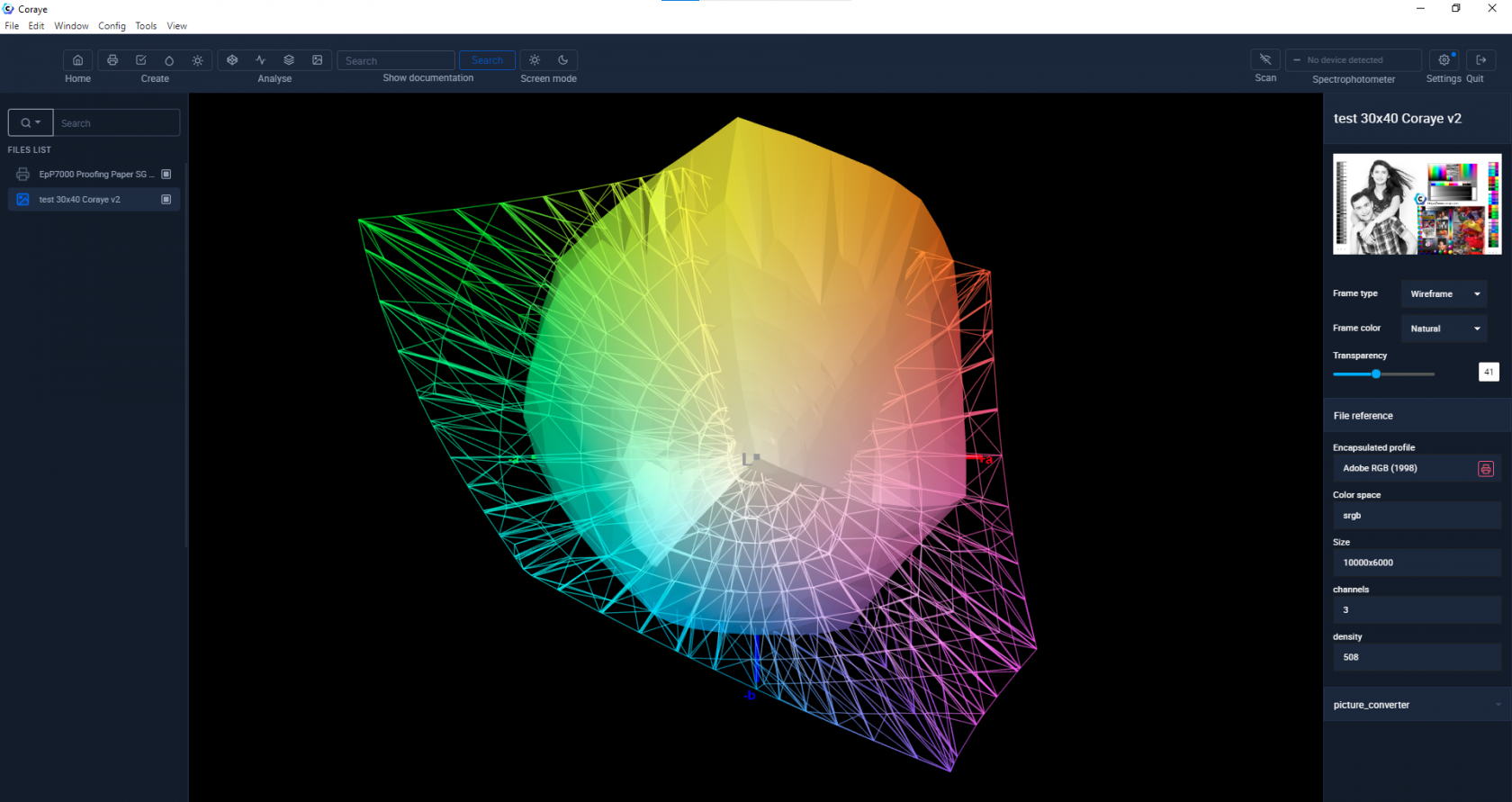
There are four rendering methods:

#### **Relative colorimetry** - compression of out-of-gamut colors to the closest color, with white shifting

\- Saturated colors that are outside the destination space will all be overwritten, but the common colors between the source space and the destination space will not be changed.  
This rendering mode is suitable for images that do not contain a lot of saturated colors.

When using this colorimetric rendering mode, it is possible to activate the **black point compensation,** which will make it possible to obtain harmonious black gradients.

[![image-1636392211627.png](https://wiki.coraye.com/uploads/images/gallery/2021-11/scaled-1680-/image-1636392211627.png)](https://wiki.coraye.com/uploads/images/gallery/2021-11/image-1636392211627.png)
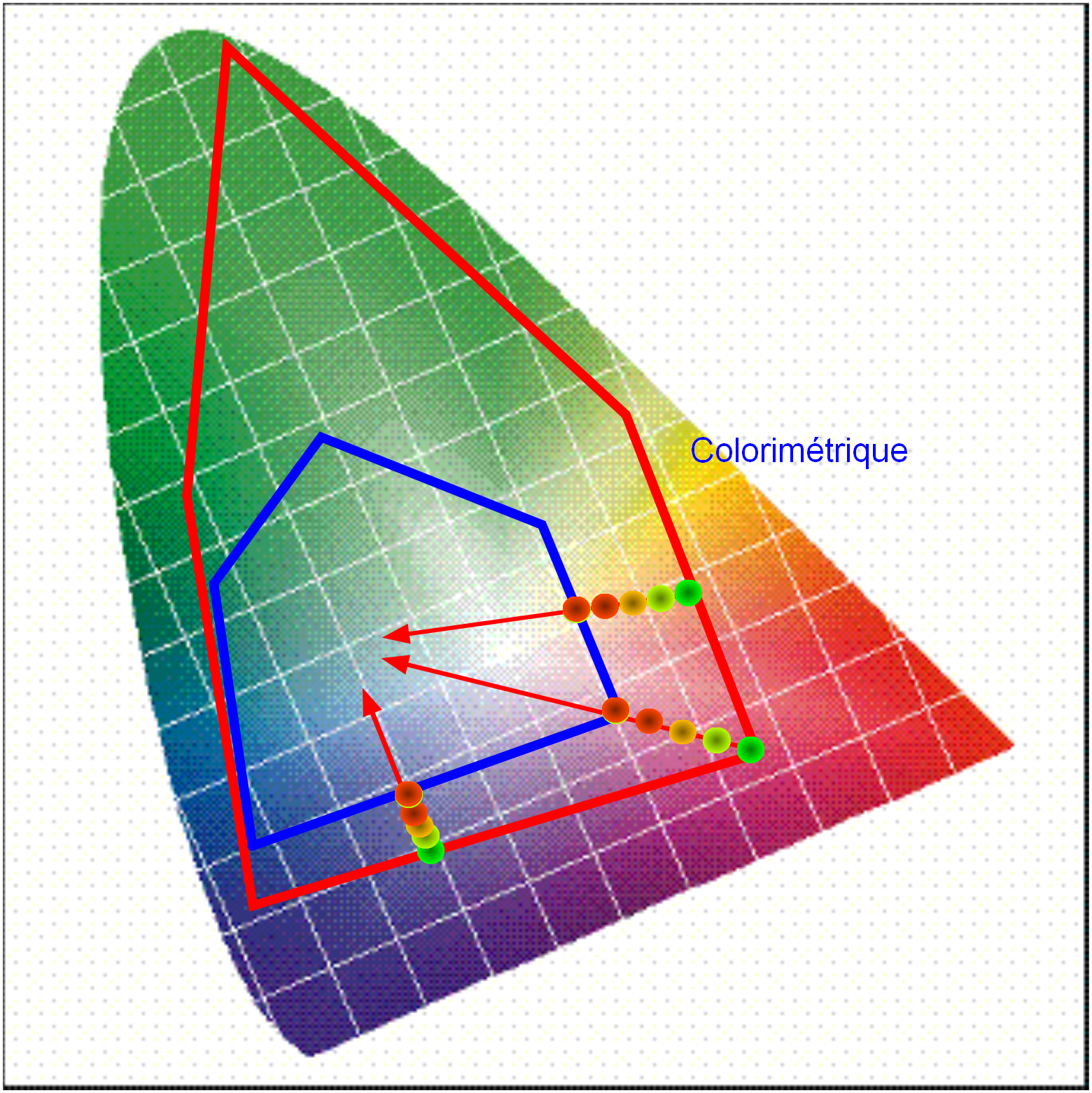
#### **Perceptual or perceptual** - homothetic compression from the source gamut to the destination gamut

The colors in the source space will all be compressed in the destination space.  
This will have the effect of desaturating all the colors of the image so as to preserve the details contained in the most saturated colors.

[![image-1636392266900.png](https://wiki.coraye.com/uploads/images/gallery/2021-11/scaled-1680-/image-1636392266900.png)](https://wiki.coraye.com/uploads/images/gallery/2021-11/image-1636392266900.png)
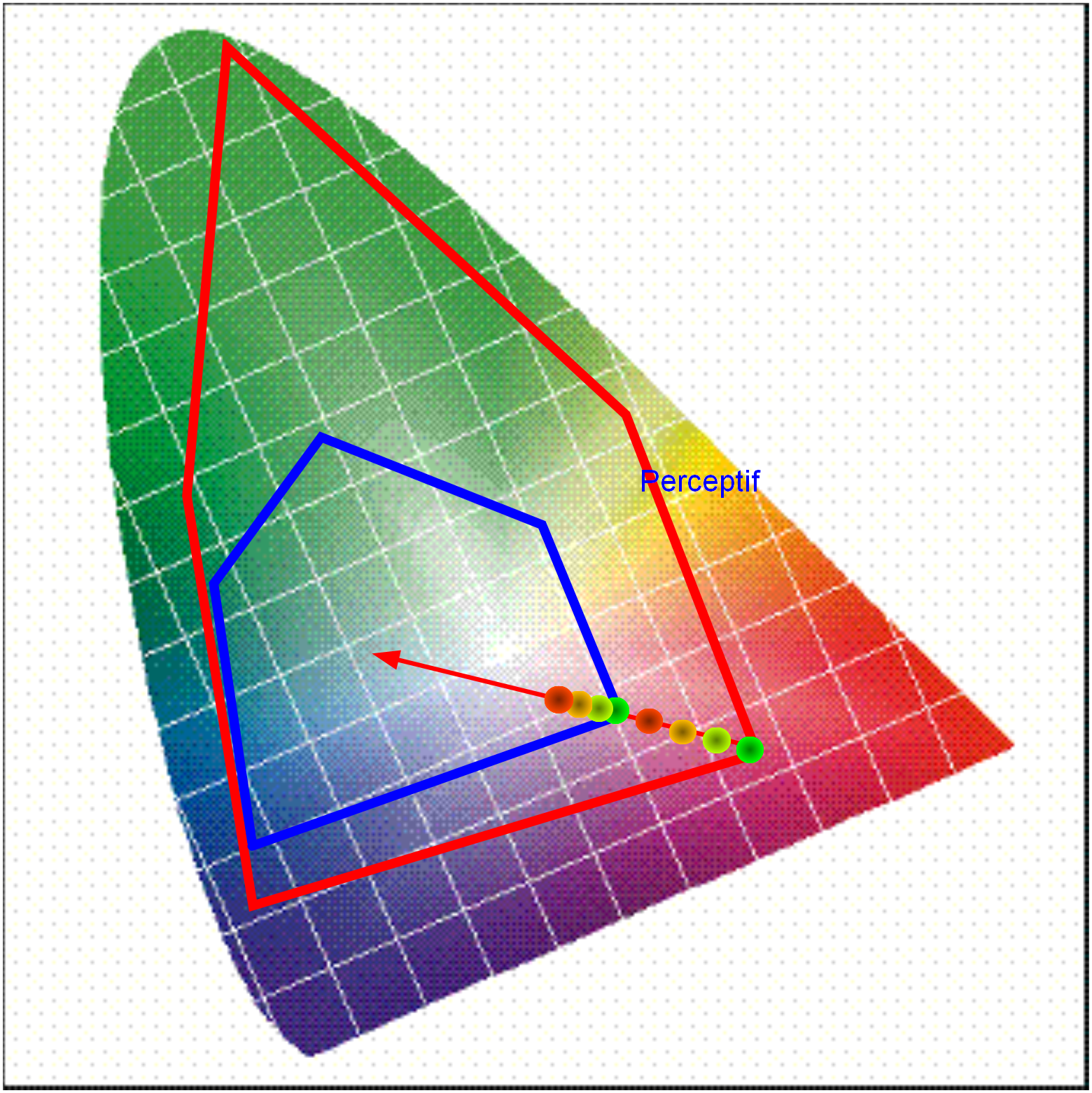
#### **Absolute colorimetry** - compression of non-gamut colors to the closest color, with paper simulation  
⦁ application: proofing  
  
**Saturation** - maximization of saturation  
⦁ application: presentat. graph (histograms, ...)

[Next &gt;](https://wiki.coraye.com/books/coraye-the-prerequisites-en/chapter/spectrophotometers-en "Spectrophotometers")

# Pantone color charts

Did you know that the Pantone® company, in those early days, manufactured varnishes to cover the nails of these ladies?  
Today we know them mainly for their color charts used in the field of printing and industry.  
Because if these "Pantoniers" are useful for colorists, they have become reference points in the field of color.  
They are used to communicate, research and control colors.  
But beware ! misused, they could cause a lot of problems ...

<div data-mobiledoc="{"version":"0.3.2","atoms":[["soft-return","",{}],["soft-return","",{}],["soft-return","",{}],["soft-return","",{}],["soft-return","",{}],["soft-return","",{}],["soft-return","",{}],["soft-return","",{}],["soft-return","",{}],["soft-return","",{}],["soft-return","",{}],["soft-return","",{}],["soft-return","",{}],["soft-return","",{}],["soft-return","",{}],["soft-return","",{}],["soft-return","",{}],["soft-return","",{}],["soft-return","",{}],["soft-return","",{}],["soft-return","",{}],["soft-return","",{}],["soft-return","",{}],["soft-return","",{}],["soft-return","",{}],["soft-return","",{}],["soft-return","",{}],["soft-return","",{}],["soft-return","",{}],["soft-return","",{}],["soft-return","",{}],["soft-return","",{}],["soft-return","",{}],["soft-return","",{}],["soft-return","",{}],["soft-return","",{}],["soft-return","",{}],["soft-return","",{}],["soft-return","",{}],["soft-return","",{}],["soft-return","",{}],["soft-return","",{}],["soft-return","",{}],["soft-return","",{}],["soft-return","",{}],["soft-return","",{}],["soft-return","",{}]],"cards":[["image",{"src":"https://blog.coraye.com/content/images/2020/11/ongles.jpg"}],["image",{"src":"https://blog.coraye.com/content/images/2020/11/Pantonier.jpg"}],["image",{"src":"https://blog.coraye.com/content/images/2020/11/Mesure-pantonier-Myiro-3.JPG","caption":"Les couleurs mesurées sur les pantoniers ont des écarts par rapport aux valeurs Lab officielles"}],["image",{"src":"https://blog.coraye.com/content/images/2020/11/Capture-color-14.png"}],["image",{"src":"https://blog.coraye.com/content/images/2020/11/Export-swatchbook-1.png"}]],"markups":[["strong"]],"sections":[[1,"p",[[0,[],0,"Savez vous que la société Pantone®, dans ces débuts, fabriquait des vernis pour recouvrir les ongles de ces dames ?"],[1,[],0,0],[0,[],0,"Aujourd" id="bkmrk-"><div data-mobiledoc="{"version":"0.3.2","atoms":[["soft-return","",{}],["soft-return","",{}],["soft-return","",{}],["soft-return","",{}],["soft-return","",{}],["soft-return","",{}],["soft-return","",{}],["soft-return","",{}],["soft-return","",{}],["soft-return","",{}],["soft-return","",{}],["soft-return","",{}],["soft-return","",{}],["soft-return","",{}],["soft-return","",{}],["soft-return","",{}],["soft-return","",{}],["soft-return","",{}],["soft-return","",{}],["soft-return","",{}],["soft-return","",{}],["soft-return","",{}],["soft-return","",{}],["soft-return","",{}],["soft-return","",{}],["soft-return","",{}],["soft-return","",{}],["soft-return","",{}],["soft-return","",{}],["soft-return","",{}],["soft-return","",{}],["soft-return","",{}],["soft-return","",{}],["soft-return","",{}],["soft-return","",{}],["soft-return","",{}],["soft-return","",{}],["soft-return","",{}],["soft-return","",{}],["soft-return","",{}],["soft-return","",{}],["soft-return","",{}],["soft-return","",{}],["soft-return","",{}],["soft-return","",{}],["soft-return","",{}],["soft-return","",{}]],"cards":[["image",{"src":"https://blog.coraye.com/content/images/2020/11/ongles.jpg"}],["image",{"src":"https://blog.coraye.com/content/images/2020/11/Pantonier.jpg"}],["image",{"src":"https://blog.coraye.com/content/images/2020/11/Mesure-pantonier-Myiro-3.JPG","caption":"Les couleurs mesurées sur les pantoniers ont des écarts par rapport aux valeurs Lab officielles"}],["image",{"src":"https://blog.coraye.com/content/images/2020/11/Capture-color-14.png"}],["image",{"src":"https://blog.coraye.com/content/images/2020/11/Export-swatchbook-1.png"}]],"markups":[["strong"]],"sections":[[1,"p",[[0,[],0,"Savez vous que la société Pantone®, dans ces débuts, fabriquait des vernis pour recouvrir les ongles de ces dames ?"],[1,[],0,0],[0,[],0,"Aujourd"><div>![](https://blog.coraye.com/content/images/2020/11/ongles.jpg)</div></div></div><div id="bkmrk--0"></div>#### The history of PANTONE

<div data-mobiledoc="{"version":"0.3.2","atoms":[["soft-return","",{}],["soft-return","",{}],["soft-return","",{}],["soft-return","",{}],["soft-return","",{}],["soft-return","",{}],["soft-return","",{}],["soft-return","",{}],["soft-return","",{}],["soft-return","",{}],["soft-return","",{}],["soft-return","",{}],["soft-return","",{}],["soft-return","",{}],["soft-return","",{}],["soft-return","",{}],["soft-return","",{}],["soft-return","",{}],["soft-return","",{}],["soft-return","",{}],["soft-return","",{}],["soft-return","",{}],["soft-return","",{}],["soft-return","",{}],["soft-return","",{}],["soft-return","",{}],["soft-return","",{}],["soft-return","",{}],["soft-return","",{}],["soft-return","",{}],["soft-return","",{}],["soft-return","",{}],["soft-return","",{}],["soft-return","",{}],["soft-return","",{}],["soft-return","",{}],["soft-return","",{}],["soft-return","",{}],["soft-return","",{}],["soft-return","",{}],["soft-return","",{}],["soft-return","",{}],["soft-return","",{}],["soft-return","",{}],["soft-return","",{}],["soft-return","",{}],["soft-return","",{}]],"cards":[["image",{"src":"https://blog.coraye.com/content/images/2020/11/ongles.jpg"}],["image",{"src":"https://blog.coraye.com/content/images/2020/11/Pantonier.jpg"}],["image",{"src":"https://blog.coraye.com/content/images/2020/11/Mesure-pantonier-Myiro-3.JPG","caption":"Les couleurs mesurées sur les pantoniers ont des écarts par rapport aux valeurs Lab officielles"}],["image",{"src":"https://blog.coraye.com/content/images/2020/11/Capture-color-14.png"}],["image",{"src":"https://blog.coraye.com/content/images/2020/11/Export-swatchbook-1.png"}]],"markups":[["strong"]],"sections":[[1,"p",[[0,[],0,"Savez vous que la société Pantone®, dans ces débuts, fabriquait des vernis pour recouvrir les ongles de ces dames ?"],[1,[],0,0],[0,[],0,"Aujourd" id="bkmrk-the-pantone-company-"><div data-mobiledoc="{"version":"0.3.2","atoms":[["soft-return","",{}],["soft-return","",{}],["soft-return","",{}],["soft-return","",{}],["soft-return","",{}],["soft-return","",{}],["soft-return","",{}],["soft-return","",{}],["soft-return","",{}],["soft-return","",{}],["soft-return","",{}],["soft-return","",{}],["soft-return","",{}],["soft-return","",{}],["soft-return","",{}],["soft-return","",{}],["soft-return","",{}],["soft-return","",{}],["soft-return","",{}],["soft-return","",{}],["soft-return","",{}],["soft-return","",{}],["soft-return","",{}],["soft-return","",{}],["soft-return","",{}],["soft-return","",{}],["soft-return","",{}],["soft-return","",{}],["soft-return","",{}],["soft-return","",{}],["soft-return","",{}],["soft-return","",{}],["soft-return","",{}],["soft-return","",{}],["soft-return","",{}],["soft-return","",{}],["soft-return","",{}],["soft-return","",{}],["soft-return","",{}],["soft-return","",{}],["soft-return","",{}],["soft-return","",{}],["soft-return","",{}],["soft-return","",{}],["soft-return","",{}],["soft-return","",{}],["soft-return","",{}]],"cards":[["image",{"src":"https://blog.coraye.com/content/images/2020/11/ongles.jpg"}],["image",{"src":"https://blog.coraye.com/content/images/2020/11/Pantonier.jpg"}],["image",{"src":"https://blog.coraye.com/content/images/2020/11/Mesure-pantonier-Myiro-3.JPG","caption":"Les couleurs mesurées sur les pantoniers ont des écarts par rapport aux valeurs Lab officielles"}],["image",{"src":"https://blog.coraye.com/content/images/2020/11/Capture-color-14.png"}],["image",{"src":"https://blog.coraye.com/content/images/2020/11/Export-swatchbook-1.png"}]],"markups":[["strong"]],"sections":[[1,"p",[[0,[],0,"Savez vous que la société Pantone®, dans ces débuts, fabriquait des vernis pour recouvrir les ongles de ces dames ?"],[1,[],0,0],[0,[],0,"Aujourd"><div>The Pantone company was born in the United States, in 1866, to promote a color chart designed for cosmetic products. And she will do just that for years to come. Until one of its distant directors, Lawrence Herbert, bought it in 1962 and launched the following year, in 1963, The **Pantone Matching System (PMS)** .</div><div> It was then only a question of putting order in the communication on the colors by a system of **code given to each shade** of color.  
This remains the primary function of the pantone color chart.</div></div></div>#### PANTONE Colors

<div data-mobiledoc="{"version":"0.3.2","atoms":[["soft-return","",{}],["soft-return","",{}],["soft-return","",{}],["soft-return","",{}],["soft-return","",{}],["soft-return","",{}],["soft-return","",{}],["soft-return","",{}],["soft-return","",{}],["soft-return","",{}],["soft-return","",{}],["soft-return","",{}],["soft-return","",{}],["soft-return","",{}],["soft-return","",{}],["soft-return","",{}],["soft-return","",{}],["soft-return","",{}],["soft-return","",{}],["soft-return","",{}],["soft-return","",{}],["soft-return","",{}],["soft-return","",{}],["soft-return","",{}],["soft-return","",{}],["soft-return","",{}],["soft-return","",{}],["soft-return","",{}],["soft-return","",{}],["soft-return","",{}],["soft-return","",{}],["soft-return","",{}],["soft-return","",{}],["soft-return","",{}],["soft-return","",{}],["soft-return","",{}],["soft-return","",{}],["soft-return","",{}],["soft-return","",{}],["soft-return","",{}],["soft-return","",{}],["soft-return","",{}],["soft-return","",{}],["soft-return","",{}],["soft-return","",{}],["soft-return","",{}],["soft-return","",{}]],"cards":[["image",{"src":"https://blog.coraye.com/content/images/2020/11/ongles.jpg"}],["image",{"src":"https://blog.coraye.com/content/images/2020/11/Pantonier.jpg"}],["image",{"src":"https://blog.coraye.com/content/images/2020/11/Mesure-pantonier-Myiro-3.JPG","caption":"Les couleurs mesurées sur les pantoniers ont des écarts par rapport aux valeurs Lab officielles"}],["image",{"src":"https://blog.coraye.com/content/images/2020/11/Capture-color-14.png"}],["image",{"src":"https://blog.coraye.com/content/images/2020/11/Export-swatchbook-1.png"}]],"markups":[["strong"]],"sections":[[1,"p",[[0,[],0,"Savez vous que la société Pantone®, dans ces débuts, fabriquait des vernis pour recouvrir les ongles de ces dames ?"],[1,[],0,0],[0,[],0,"Aujourd" id="bkmrk-the-principle-of-the"><div data-mobiledoc="{"version":"0.3.2","atoms":[["soft-return","",{}],["soft-return","",{}],["soft-return","",{}],["soft-return","",{}],["soft-return","",{}],["soft-return","",{}],["soft-return","",{}],["soft-return","",{}],["soft-return","",{}],["soft-return","",{}],["soft-return","",{}],["soft-return","",{}],["soft-return","",{}],["soft-return","",{}],["soft-return","",{}],["soft-return","",{}],["soft-return","",{}],["soft-return","",{}],["soft-return","",{}],["soft-return","",{}],["soft-return","",{}],["soft-return","",{}],["soft-return","",{}],["soft-return","",{}],["soft-return","",{}],["soft-return","",{}],["soft-return","",{}],["soft-return","",{}],["soft-return","",{}],["soft-return","",{}],["soft-return","",{}],["soft-return","",{}],["soft-return","",{}],["soft-return","",{}],["soft-return","",{}],["soft-return","",{}],["soft-return","",{}],["soft-return","",{}],["soft-return","",{}],["soft-return","",{}],["soft-return","",{}],["soft-return","",{}],["soft-return","",{}],["soft-return","",{}],["soft-return","",{}],["soft-return","",{}],["soft-return","",{}]],"cards":[["image",{"src":"https://blog.coraye.com/content/images/2020/11/ongles.jpg"}],["image",{"src":"https://blog.coraye.com/content/images/2020/11/Pantonier.jpg"}],["image",{"src":"https://blog.coraye.com/content/images/2020/11/Mesure-pantonier-Myiro-3.JPG","caption":"Les couleurs mesurées sur les pantoniers ont des écarts par rapport aux valeurs Lab officielles"}],["image",{"src":"https://blog.coraye.com/content/images/2020/11/Capture-color-14.png"}],["image",{"src":"https://blog.coraye.com/content/images/2020/11/Export-swatchbook-1.png"}]],"markups":[["strong"]],"sections":[[1,"p",[[0,[],0,"Savez vous que la société Pantone®, dans ces débuts, fabriquait des vernis pour recouvrir les ongles de ces dames ?"],[1,[],0,0],[0,[],0,"Aujourd"><div>The principle of the best possible color rendering, developed in printing with hexachromy (6 CMYK + Orange and Green colors), has led to the development of a palette of 13 basic colors.   
These 13 basic colors were supplemented, in the years following their development, by 5 other colors.  
What means that today, the pantone color chart, is a variation of **18 basic colors:**</div></div></div>- [Black](https://fr.wikipedia.org/wiki/Noir "Noir") primary ( *black* );
- [White](https://fr.wikipedia.org/wiki/Blanc "Blanc") transparent ( *white transparent* ) to lighten the color;
- [Yellow](https://fr.wikipedia.org/wiki/Jaune "Yellow") primary ( *yellow* );
- [Rouge](https://fr.wikipedia.org/wiki/Rouge "Rouge") (*bright red*) ;
- *Warm red* ( *warm red* );
- Ruby *red* ( *rubine red* );
- *Rhodamine red* ( *rhodamine red* ), or [magenta](https://fr.wikipedia.org/wiki/Magenta_(couleur) "Magenta (color)") ;
- [Rose](https://fr.wikipedia.org/wiki/Rose_(couleur) "Pink (color)") (*pink*) ;
- [Violet](https://fr.wikipedia.org/wiki/Violet "Violet") (*purple*) ;
- [Blue](https://fr.wikipedia.org/wiki/Bleu "Bleu") ( *dark blue* );
- Reflex *blue* , a sort of very pure [indigo](https://fr.wikipedia.org/wiki/Indigo "Indigo") blue ;
- Primary *blue* ( *process blue* ), stronger than [cyan](https://fr.wikipedia.org/wiki/Cyan "Cyan") ;
- [Vert](https://fr.wikipedia.org/wiki/Vert "Vert") (*green*).
- Red 032 ( pure [red](https://fr.wikipedia.org/wiki/Rouge "Rouge") );
- Orange 021 ( pure [orange](https://fr.wikipedia.org/wiki/Orange_(couleur) "Orange (color)") );
- [Yellow](https://fr.wikipedia.org/wiki/Jaune "Yellow") 012 (a more intense yellow than the primary yellow);
- [Violet](https://fr.wikipedia.org/wiki/Violet "Violet")
- [Blue](https://fr.wikipedia.org/wiki/Bleu "Bleu") 072 (a less purplish blue than the reflex blue).

Pantone, by combining these primary inks created thousands of colors.  
Depending on the media on which the inks are printed, the color rendering will differ.  
This is why there are several PANTONE (Pantonier) color charts such as:

- Pantone C (coated), for [coated paper](https://fr.wikipedia.org/wiki/Papier_couch%C3%A9 "Coated paper") ;
- Pantone U (uncoated), for uncoated paper;
- Pantone M (matted), for matt paper.

The advantage of PANTONE inks for a printer, is to print colors which cannot be reproduced in CMYK or to carry out prints in the field of packaging.  
**But beware, the use of additional colors in traditional printing at a cost ...**

#### PANTONE and digital printing

In digital printing, (take inkjet for example), printers can use Cyan, Magenta, Yellow, Black, Orange, Green, Violet, Red, Blue inks to reproduce saturated colors.  
But also clear inks (Light) to increase the quality of pastel colors.  
There are also white, metallic, fluorescent inks, etc ...  
  
Each printer is able to reproduce a certain number of shades depending on:  
\- Its technology (Piezo, thermal, flexo, etc ...)  
\- The type of ink used (Eco solvent, latex (resin), pigment, sublimation, etc ...)  
\- The number of different inks that compose it  
\- The media on which we print (paper, fabrics, vinyl, tarpaulin, etc ...) )  
\- etc ...

Inkjet printers are therefore capable of reproducing a much larger color space than an offset printer which prints with CMYK inks for example.

[![image-1640779024017.png](https://wiki.coraye.com/uploads/images/gallery/2021-12/scaled-1680-/image-1640779024017.png)Isocoated v2 eci.icc (Fogra 39) vs Epson P7000 papier de type photo](https://wiki.coraye.com/uploads/images/gallery/2021-12/image-1640779024017.png)

  
So the PANTONE color chart can only be used as a reference to print a color.  
  
The question we can ask ourselves is: Is the printer capable of reproducing all the colors of a PANTONE color chart?  
Remember that the Pantone C, U or M color charts are lexicons of additional inks intended for traditional printing.

#### PANTONE and textile printing

There are other color charts for printing textiles  
\- Pantone TCX (Textile on cotton)  
\- Pantone TPX (Textile on paper)  
\- Pantone TPG (Textile on paper)  
\- Pantone fashion home + interiors  
\- etc ...  
As we can See it by comparing a Pantone C color chart (in white) and a Pantone TCX color chart (in red), the colors in the Pantone C color charts contain more saturated colors.

[![image-1640344239287.png](https://wiki.coraye.com/uploads/images/gallery/2021-12/scaled-1680-/image-1640344239287.png)Pantone TCX (Rouge) vs Pantone C (Blanc)](https://wiki.coraye.com/uploads/images/gallery/2021-12/image-1640344239287.png)

Now let's compare the profile of an Epson SC-F10000 printer using sublimation inks for printing on polyester fabric, we can see that the Pantone TCX color chart is more suitable for this printing technology.  
We can also see that there are colors from the color chart (in the blue-green) that we will not be able to reproduce.  
But there are also a lot of colors that are not in the Pantone TCX color chart that we could reproduce (Green, Yellow, Red, Blue eg)

[![image-1640345531504.png](https://wiki.coraye.com/uploads/images/gallery/2021-12/scaled-1680-/image-1640345531504.png)Pantone TCX vs Profil Epson F10000 sublimation textile](https://wiki.coraye.com/uploads/images/gallery/2021-12/image-1640345531504.png)

In conclusion, if you want to use Pantone color charts to define the colors you want to reproduce, use suitable color charts.  
Otherwise ask your printer to print the color charts for you under normal printing conditions and use the colors provided by your printer.

#### In which color mode are Pantone colors defined?

As we have seen previously, Pantone colors can be used in printing to reproduce colors that are not reproducible in CMYK.  
So the CMYK color space cannot be used because:  
1\) CMYK is dependent on a reference profile  
2\) There are Pantone colors which are not reproducible in CMYK

[![image-1640346533883.png](https://wiki.coraye.com/uploads/images/gallery/2021-12/scaled-1680-/image-1640346533883.png)Pantone C vs Isocoated v2 eci.icc (Fogra 39)](https://wiki.coraye.com/uploads/images/gallery/2021-12/image-1640346533883.png)

The color space generally used to define a Pantone color is the Lab because it is an independent color mode which relies on the perception of the human eye.

[![image-1640347053315.png](https://wiki.coraye.com/uploads/images/gallery/2021-12/scaled-1680-/image-1640347053315.png)Lab values ​​of a Pantone color chart ](https://wiki.coraye.com/uploads/images/gallery/2021-12/image-1640347053315.png)

#### **Paper swatches**

The only purpose of paper color charts is to help choose a color, but they do not claim to be precise enough to allow color control.  
The visual control also depends on the state of your Pantonier, the light environment in which you will visualize your colors and ... on you!  
Because you probably know, color is subjective.  
From the first day of use, your color charts can have significant deviations. Colors printed on a Pantone® color chart cannot have absolute values ​​and are necessarily reproduced with tolerances.  
Without forgetting the updates.  
The current Pantone® solid coated color chart contains 2663 colors, and yours?

<div data-mobiledoc="{"version":"0.3.2","atoms":[["soft-return","",{}],["soft-return","",{}],["soft-return","",{}],["soft-return","",{}],["soft-return","",{}],["soft-return","",{}],["soft-return","",{}],["soft-return","",{}],["soft-return","",{}],["soft-return","",{}],["soft-return","",{}],["soft-return","",{}],["soft-return","",{}],["soft-return","",{}],["soft-return","",{}],["soft-return","",{}],["soft-return","",{}],["soft-return","",{}],["soft-return","",{}],["soft-return","",{}],["soft-return","",{}],["soft-return","",{}],["soft-return","",{}],["soft-return","",{}],["soft-return","",{}],["soft-return","",{}],["soft-return","",{}],["soft-return","",{}],["soft-return","",{}],["soft-return","",{}],["soft-return","",{}],["soft-return","",{}],["soft-return","",{}],["soft-return","",{}],["soft-return","",{}],["soft-return","",{}],["soft-return","",{}],["soft-return","",{}],["soft-return","",{}],["soft-return","",{}],["soft-return","",{}],["soft-return","",{}],["soft-return","",{}],["soft-return","",{}],["soft-return","",{}],["soft-return","",{}],["soft-return","",{}]],"cards":[["image",{"src":"https://blog.coraye.com/content/images/2020/11/ongles.jpg"}],["image",{"src":"https://blog.coraye.com/content/images/2020/11/Pantonier.jpg"}],["image",{"src":"https://blog.coraye.com/content/images/2020/11/Mesure-pantonier-Myiro-3.JPG","caption":"Les couleurs mesurées sur les pantoniers ont des écarts par rapport aux valeurs Lab officielles"}],["image",{"src":"https://blog.coraye.com/content/images/2020/11/Capture-color-14.png"}],["image",{"src":"https://blog.coraye.com/content/images/2020/11/Export-swatchbook-1.png"}]],"markups":[["strong"]],"sections":[[1,"p",[[0,[],0,"Savez vous que la société Pantone®, dans ces débuts, fabriquait des vernis pour recouvrir les ongles de ces dames ?"],[1,[],0,0],[0,[],0,"Aujourd" id="bkmrk--5"><div data-mobiledoc="{"version":"0.3.2","atoms":[["soft-return","",{}],["soft-return","",{}],["soft-return","",{}],["soft-return","",{}],["soft-return","",{}],["soft-return","",{}],["soft-return","",{}],["soft-return","",{}],["soft-return","",{}],["soft-return","",{}],["soft-return","",{}],["soft-return","",{}],["soft-return","",{}],["soft-return","",{}],["soft-return","",{}],["soft-return","",{}],["soft-return","",{}],["soft-return","",{}],["soft-return","",{}],["soft-return","",{}],["soft-return","",{}],["soft-return","",{}],["soft-return","",{}],["soft-return","",{}],["soft-return","",{}],["soft-return","",{}],["soft-return","",{}],["soft-return","",{}],["soft-return","",{}],["soft-return","",{}],["soft-return","",{}],["soft-return","",{}],["soft-return","",{}],["soft-return","",{}],["soft-return","",{}],["soft-return","",{}],["soft-return","",{}],["soft-return","",{}],["soft-return","",{}],["soft-return","",{}],["soft-return","",{}],["soft-return","",{}],["soft-return","",{}],["soft-return","",{}],["soft-return","",{}],["soft-return","",{}],["soft-return","",{}]],"cards":[["image",{"src":"https://blog.coraye.com/content/images/2020/11/ongles.jpg"}],["image",{"src":"https://blog.coraye.com/content/images/2020/11/Pantonier.jpg"}],["image",{"src":"https://blog.coraye.com/content/images/2020/11/Mesure-pantonier-Myiro-3.JPG","caption":"Les couleurs mesurées sur les pantoniers ont des écarts par rapport aux valeurs Lab officielles"}],["image",{"src":"https://blog.coraye.com/content/images/2020/11/Capture-color-14.png"}],["image",{"src":"https://blog.coraye.com/content/images/2020/11/Export-swatchbook-1.png"}]],"markups":[["strong"]],"sections":[[1,"p",[[0,[],0,"Savez vous que la société Pantone®, dans ces débuts, fabriquait des vernis pour recouvrir les ongles de ces dames ?"],[1,[],0,0],[0,[],0,"Aujourd"><div>![](https://blog.coraye.com/content/images/2020/11/Pantonier.jpg)</div></div></div>#### **So digital?**

  
It is indeed the most reliable solution because by using a spectrophotometer and an adapted software that brings us the following advantages:  
\- Measurement precision  
\- Use of spectral values ​​or official Lab  
\- No interpretation of color  
\- Control of conditions under which the measurement is carried out.  
\- Precise quantification of the difference between the measured color and the reference values.  
\- Recording and sharing of information for better communication.  
\- Update of color charts  
\- More reliable and faster shade search.  
\- Creation and use of personalized color charts (samples of leathers, fabrics, vinyl, etc.)

<div data-mobiledoc="{"version":"0.3.2","atoms":[["soft-return","",{}],["soft-return","",{}],["soft-return","",{}],["soft-return","",{}],["soft-return","",{}],["soft-return","",{}],["soft-return","",{}],["soft-return","",{}],["soft-return","",{}],["soft-return","",{}],["soft-return","",{}],["soft-return","",{}],["soft-return","",{}],["soft-return","",{}],["soft-return","",{}],["soft-return","",{}],["soft-return","",{}],["soft-return","",{}],["soft-return","",{}],["soft-return","",{}],["soft-return","",{}],["soft-return","",{}],["soft-return","",{}],["soft-return","",{}],["soft-return","",{}],["soft-return","",{}],["soft-return","",{}],["soft-return","",{}],["soft-return","",{}],["soft-return","",{}],["soft-return","",{}],["soft-return","",{}],["soft-return","",{}],["soft-return","",{}],["soft-return","",{}],["soft-return","",{}],["soft-return","",{}],["soft-return","",{}],["soft-return","",{}],["soft-return","",{}],["soft-return","",{}],["soft-return","",{}],["soft-return","",{}],["soft-return","",{}],["soft-return","",{}],["soft-return","",{}],["soft-return","",{}]],"cards":[["image",{"src":"https://blog.coraye.com/content/images/2020/11/ongles.jpg"}],["image",{"src":"https://blog.coraye.com/content/images/2020/11/Pantonier.jpg"}],["image",{"src":"https://blog.coraye.com/content/images/2020/11/Mesure-pantonier-Myiro-3.JPG","caption":"Les couleurs mesurées sur les pantoniers ont des écarts par rapport aux valeurs Lab officielles"}],["image",{"src":"https://blog.coraye.com/content/images/2020/11/Capture-color-14.png"}],["image",{"src":"https://blog.coraye.com/content/images/2020/11/Export-swatchbook-1.png"}]],"markups":[["strong"]],"sections":[[1,"p",[[0,[],0,"Savez vous que la société Pantone®, dans ces débuts, fabriquait des vernis pour recouvrir les ongles de ces dames ?"],[1,[],0,0],[0,[],0,"Aujourd" id="bkmrk--6"><div data-mobiledoc="{"version":"0.3.2","atoms":[["soft-return","",{}],["soft-return","",{}],["soft-return","",{}],["soft-return","",{}],["soft-return","",{}],["soft-return","",{}],["soft-return","",{}],["soft-return","",{}],["soft-return","",{}],["soft-return","",{}],["soft-return","",{}],["soft-return","",{}],["soft-return","",{}],["soft-return","",{}],["soft-return","",{}],["soft-return","",{}],["soft-return","",{}],["soft-return","",{}],["soft-return","",{}],["soft-return","",{}],["soft-return","",{}],["soft-return","",{}],["soft-return","",{}],["soft-return","",{}],["soft-return","",{}],["soft-return","",{}],["soft-return","",{}],["soft-return","",{}],["soft-return","",{}],["soft-return","",{}],["soft-return","",{}],["soft-return","",{}],["soft-return","",{}],["soft-return","",{}],["soft-return","",{}],["soft-return","",{}],["soft-return","",{}],["soft-return","",{}],["soft-return","",{}],["soft-return","",{}],["soft-return","",{}],["soft-return","",{}],["soft-return","",{}],["soft-return","",{}],["soft-return","",{}],["soft-return","",{}],["soft-return","",{}]],"cards":[["image",{"src":"https://blog.coraye.com/content/images/2020/11/ongles.jpg"}],["image",{"src":"https://blog.coraye.com/content/images/2020/11/Pantonier.jpg"}],["image",{"src":"https://blog.coraye.com/content/images/2020/11/Mesure-pantonier-Myiro-3.JPG","caption":"Les couleurs mesurées sur les pantoniers ont des écarts par rapport aux valeurs Lab officielles"}],["image",{"src":"https://blog.coraye.com/content/images/2020/11/Capture-color-14.png"}],["image",{"src":"https://blog.coraye.com/content/images/2020/11/Export-swatchbook-1.png"}]],"markups":[["strong"]],"sections":[[1,"p",[[0,[],0,"Savez vous que la société Pantone®, dans ces débuts, fabriquait des vernis pour recouvrir les ongles de ces dames ?"],[1,[],0,0],[0,[],0,"Aujourd"><div>![](https://blog.coraye.com/content/images/2020/11/Mesure-pantonier-Myiro-3.JPG)</div></div></div><div id="bkmrk--7"></div>#### Pantone + Color Bridge swatches

Attention danger ! these swatches do not contain the values ​​of the reference Pantone colors, but the Pantone colors converted to CMYK.  
So this gives reduced colors to the CMYK space, it can only be useful for offset printing to preview what your Pantone color will give you in CMYK if you will not be using an additional Pantone color.  
The question is:  
\- Is the CMYK space that my printer will use the same as the one used to convert Pantone colors on my Color Bridge swatch?  
\- Do I need a Color Bridge CMYK swatch when printing on a 12 color inkjet printer?

Similar articles:

[https://www.coraye.com/en/posts/de-la-creation-a-limpression-episode-10-2](https://www.coraye.com/en/posts/de-la-creation-a-limpression-episode-10-2)

[https://www.coraye.com/en/posts/from-creation-to-printing-episode-9](https://www.coraye.com/en/posts/from-creation-to-printing-episode-9)

[https://www.coraye.com/en/posts/de-la-creation-a-limpression-episode-8-2](https://www.coraye.com/en/posts/de-la-creation-a-limpression-episode-8-2)

[https://www.coraye.com/en/posts/from-creation-to-printing-episode-6](https://www.coraye.com/en/posts/from-creation-to-printing-episode-6)

[https://www.coraye.com/en/posts/from-creation-to-printing-episode-5](https://www.coraye.com/en/posts/from-creation-to-printing-episode-5)

[https://www.coraye.com/en/posts/from-creation-to-printing-episode-2](https://www.coraye.com/en/posts/from-creation-to-printing-episode-2)

[https://www.coraye.com/en/posts/from-creation-to-printing-episode-1](https://www.coraye.com/en/posts/from-creation-to-printing-episode-1)

# Spectrophotometers (En)


# Spectral values

<span>As we saw in the first chapter on light + eye = color, </span>  
<span>The eye collects information about electromagnetic frequencies, and the translation of these radiations by the brain is the sensation of color.</span>  
<span>Let's take a closer look at the visible spectrum.</span>

#### <span>Monochromatic color</span>

<span>One qualifies as monochromatic (from the Greek </span>*<span>mono-</span>*<span> , </span>*<span>one</span>*<span> and </span>*<span>chromos</span>*<span> , </span>*<span>color</span>*<span> ) a light whose color is formed only of a frequency or, of a very narrow band of frequency at the level of its spectrum.</span>

<span>A source </span><span class="lienGlossaire" title="A light whose ..."><span>monochromatic</span></span><span> emits </span><span class="lienGlossaire"><span>electromagnetic radiation</span></span><span> at a </span><span class="lienGlossaire"><span>length</span></span><span> of </span><span class="lienGlossaire"><span>wave</span></span><span> accurately. For example, <span class="lienGlossaire" title="A laser is a device that emits light (electromagnetic radiation) ...">laser </span></span><span class="lienGlossaire" title="Radiation, synonymous with radiation in physics, refers to the process of emission or ..."><span>radiation</span></span> <span> has only one component (one wavelength), so it has monochromatic light emission. The visible spectrum allows only a certain number of monochromatic colors</span>

[![image-1636645656922.png](https://wiki.coraye.com/uploads/images/gallery/2021-11/scaled-1680-/image-1636645656922.png)](https://wiki.coraye.com/uploads/images/gallery/2021-11/image-1636645656922.png)

[![image-1636645681245.png](https://wiki.coraye.com/uploads/images/gallery/2021-11/scaled-1680-/image-1636645681245.png)](https://wiki.coraye.com/uploads/images/gallery/2021-11/image-1636645681245.png)

#### <span>Polychromatic Color</span>

<span>Why does the color pink not appear in the visible light spectrum?</span>

<span>Because a color is by definition associated with a wavelength of electromagnetic radiation (or a very restricted range).</span>

<span>Pink is not associated with a wavelength, so it is not a color. (Just like brown, black, white). It is associated with several wavelengths (it has a wide spectral range).</span>

<span>If we perceive “pink” well, it is because our eyes are endowed with three types of receptors sensitive to blue, red and green.</span>

<span>With the correct mixture (in certain proportions) of spectral components, you simultaneously stimulate the three types of receptors, and our brain carries out an additive synthesis of these three simultaneous stimuli. This results in a “well defined” sensation which is that of pink!</span>

<span>Just like white which is the sum of the wavelengths of the visible spectrum.</span>

---

#### <span>The spectrophotometer</span>

<span>As we saw in the chapter on spectrophotometers, the measured sample sends back waves that it has not absorbed back to the spectrophotometer.</span>  
<span>The prism system will break down these waves to redirect them to a photosensitive sensor.</span>  
<span>The received signal, once amplified, will display the reflectance curve (spectral curve) corresponding to the measured "color".</span>

[![image-1636581395846.png](https://wiki.coraye.com/uploads/images/gallery/2021-11/scaled-1680-/image-1636581395846.png)](https://wiki.coraye.com/uploads/images/gallery/2021-11/image-1636581395846.png)

<span>Result of the measurement of a "Pink" sample and a "White" sample</span>

[![image-1636646338497.png](https://wiki.coraye.com/uploads/images/gallery/2021-11/scaled-1680-/image-1636646338497.png)<span>Result of the measurement of a "Pink" sample and a "White" sample</span>](https://wiki.coraye.com/uploads/images/gallery/2021-11/image-1636646338497.png)

<p class="callout info align-center">**<span>The color is saved as a file containing the values ​​of the spectral curve.</span>**  
**<span>The XYZ and Lab values ​​were calculated by an algorithm which converts the spectral curve into a color seen by the human eye.</span>**</p>

[![image-1636647459758.png](https://wiki.coraye.com/uploads/images/gallery/2021-11/scaled-1680-/image-1636647459758.png)](https://wiki.coraye.com/uploads/images/gallery/2021-11/image-1636647459758.png)

<p class="callout success"><span>For more information see the Wikipedia article: </span>[<span>Polychromatic light</span>](https://fr.wikipedia.org/wiki/Lumi%C3%A8re_polychromatique "Polychromatic light")</p>

[<span>Next&gt;</span>](https://wiki.coraye.com/books/coraye-les-pre-requis-fr/page/les-instruments-de-mesure "Spectrophotometers")

# Measuring instruments

<span>Each of these measuring instruments have a specific role, in order to differentiate them, we will give you a brief description.</span>

<table border="1" id="bkmrk-spectrophotom%C3%A8tre-co"><tbody><tr><td class="align-center"><span>Spectrophotometer</span></td><td class="align-center"><span>Colorimeter</span></td></tr><tr><td class="align-center">[![image-1636571694636.png](https://wiki.coraye.com/uploads/images/gallery/2021-11/scaled-1680-/image-1636571694636.png)](https://wiki.coraye.com/uploads/images/gallery/2021-11/image-1636571694636.png)</td><td class="align-center">[![image-1636571898708.png](https://wiki.coraye.com/uploads/images/gallery/2021-11/scaled-1680-/image-1636571898708.png)](https://wiki.coraye.com/uploads/images/gallery/2021-11/image-1636571898708.png)</td></tr><tr><td class="align-center"><span>Spectrodensitometer</span></td><td class="align-center"><span>Densitometer</span></td></tr><tr><td class="align-center">[![image-1636571353949.png](https://wiki.coraye.com/uploads/images/gallery/2021-11/scaled-1680-/image-1636571353949.png)](https://wiki.coraye.com/uploads/images/gallery/2021-11/image-1636571353949.png)</td><td class="align-center">[![image-1636571598734.png](https://wiki.coraye.com/uploads/images/gallery/2021-11/scaled-1680-/image-1636571598734.png)](https://wiki.coraye.com/uploads/images/gallery/2021-11/image-1636571598734.png)</td></tr><tr><td class="align-center"><span>Automatic spectrophotometer</span></td><td class="align-center"><span>Sphere spectrophotometer</span></td></tr><tr><td class="align-center">[![image-1634042922874.png](https://wiki.coraye.com/uploads/images/gallery/2021-10/scaled-1680-/image-1634042922874.png)](https://wiki.coraye.com/uploads/images/gallery/2021-10/image-1634042922874.png)</td><td class="align-center">[![image-1634042420445.png](https://wiki.coraye.com/uploads/images/gallery/2021-10/scaled-1680-/image-1634042420445.png)](https://wiki.coraye.com/uploads/images/gallery/2021-10/image-1634042420445.png)</td></tr></tbody></table>

---

#### <span>The XRite I1 Pro type spectrophotometer and Konica Minolta Myro</span>

<table border="1" id="bkmrk-xrite-i1-pro-konica-"><tbody><tr><td class="align-center"><span>XRite I1 Pro</span></td><td class="align-center"><span>Konica Minolta Myiro</span></td></tr><tr><td class="align-center">[![image-1636571694636.png](https://wiki.coraye.com/uploads/images/gallery/2021-11/scaled-1680-/image-1636571694636.png)](https://wiki.coraye.com/uploads/images/gallery/2021-11/image-1636571694636.png)

</td><td class="align-center">[![image-1636640157926.png](https://wiki.coraye.com/uploads/images/gallery/2021-11/scaled-1680-/image-1636640157926.png)](https://wiki.coraye.com/uploads/images/gallery/2021-11/image-1636640157926.png)

</td></tr></tbody></table>

##### <span>Functions:</span>

<span>- Target measurement to calibrate and characterize printers</span>  
<span>- Spot measurement of flat and opaque color samples (spectral measurement)</span>  
<span>- Illuminant measurement (spectral measurement)</span>  
<span>- Screen and video projector calibration</span>  
<span>- Density measurement - Color</span>  
<span>search</span>  
<span>- Compare colors (Delta E)</span>  
<span>- etc ...</span>  
<span>These spectrophotometers do not have a screen and need to be connected to a computer equipped with software (Coraye for example).</span>  
<span>The spectrophotometer in itself is only a measuring device and the functions depend on the software which controls it.</span>

<p class="callout success">**<span>Find out more about </span>[<span>the different spectrophotometers and how they work</span>](https://www.xrite.com/fr-fr/learning-color-education/other-resources/what-is-a-spectrophotometer#:~:text=Spectrophotom%C3%A8tre%20le%20plus%20fr%C3%A9quemment%20utilis%C3%A9,%C5%93il%20humain%20per%C3%A7oit%20la%20couleur. "The different spectrophotometers and their operation")**</p>

#### <span>How a spectrophotometer works</span>

[![image-1636581395846.png](https://wiki.coraye.com/uploads/images/gallery/2021-11/scaled-1680-/image-1636581395846.png)](https://wiki.coraye.com/uploads/images/gallery/2021-11/image-1636581395846.png)

---

#### <span>XRite eXact type spectrodensitometers</span>

[![image-1636571353949.png](https://wiki.coraye.com/uploads/images/gallery/2021-11/scaled-1680-/image-1636571353949.png)](https://wiki.coraye.com/uploads/images/gallery/2021-11/image-1636571353949.png)

<span>This instrument is generally used in offset printing, flexography, gravure printing workshops, etc.</span>  
<span>It is used to:</span>  
<span>- Measure densities, fattening.</span>  
<span>- Measure color samples</span>  
<span>- Carry out color research - Check</span>  
<span>the whiteness of a paper</span>  
<span>- Compare colors, densities</span>  
<span>- etc ...</span>  
<span>It is an autonomous spectrophotometer with a screen and on-board software.</span>  
<span>This spectrophotometer can also be connected to software to extend its possibilities.</span>

---

#### <span>Automatic spectrophotometers</span>

[![image-1634042922874.png](https://wiki.coraye.com/uploads/images/gallery/2021-10/scaled-1680-/image-1634042922874.png)](https://wiki.coraye.com/uploads/images/gallery/2021-10/image-1634042922874.png)

<span>These spectrophotometers are generally used to calibrate printers.</span>  
<span>They require software to drive them.</span>

---

#### <span>Sphere spectrophotometer</span>

[![image-1634042420445.png](https://wiki.coraye.com/uploads/images/gallery/2021-10/scaled-1680-/image-1634042420445.png)](https://wiki.coraye.com/uploads/images/gallery/2021-10/image-1634042420445.png)

<span>These spectrophotometers make it possible to measure complicated materials such as the sheet metal of cars, fabrics or reflective materials.</span>  
<span>It makes it possible to dissociate the specular relection (shiny surface) and the diffuse reflection (rough surface)</span>  
<span>It is an autonomous spectrophotometer with a screen and an on-board software.</span>  
<span>This spectrophotometer can also be connected to software to extend its possibilities.</span>

[![image-1636643771753.png](https://wiki.coraye.com/uploads/images/gallery/2021-11/scaled-1680-/image-1636643771753.png)](https://wiki.coraye.com/uploads/images/gallery/2021-11/image-1636643771753.png)

---

#### <span>Colorimeter or calibration probe</span>

[![image-1636571898708.png](https://wiki.coraye.com/uploads/images/gallery/2021-11/scaled-1680-/image-1636571898708.png)](https://wiki.coraye.com/uploads/images/gallery/2021-11/image-1636571898708.png)

<span>This colorimeter is used to calibrate screens and video projectors only.</span>

---

#### <span>Densitometer</span>

[![image-1636571598734.png](https://wiki.coraye.com/uploads/images/gallery/2021-11/scaled-1680-/image-1636571598734.png)](https://wiki.coraye.com/uploads/images/gallery/2021-11/image-1636571598734.png)

<span>Densitometers are workshop instruments that only measure densities, in other words, the opacity of an ink or a medium.</span>  
<span>It does not provide a color value like spectrophotometers or spectrodensitometers do.</span>

<span>Densitometers have been replaced by manufacturers by spectrodensitometers.</span>

<p class="callout success"><span>For more information, see the chapter: </span>[<span>Displaying the density</span>](https://wiki.coraye.com/books/manuel-coraye-fr/page/afficher-la-densite "Show density")</p>

# M0, M1, M2, M3 modes

### <span>Fluorescent effect of optical brighteners</span>

<span>Optical brighteners (or OBA for Optical Brightening Agent) are components added to the print medium to make them appear “whiter than white”. The principle is quite similar to that of bluing additives in detergents. OBAs capture ultra violet (UV), these electromagnetic waves invisible to the human eye because of wavelengths less than 400 nanometers (nm), and transform them into electromagnetic waves barely visible to our eye (of lengths of wave between 400 and 450 nm). This is the principle of fluorescence. These OBAs thus reinforce the shine of the paper, even and above all, when it is not coated.</span>  
<span>Optical brighteners also have the effect of modifying the perception of colors printed on the supports which contain them. And since these agents react to UV, the printed colors will not be seen identically when observed, under lights containing or not containing UV, and this even if the two light sources have the same white temperature. This phenomenon is reinforced by the fact that the components of colored pigments used in offset or digital printing can also be subject to the phenomenon of fluorescence.</span>

**<span>The image below shows the three combined spectral curves M0, M1 and M2 of the measured color of a support devoid of optical brightener.</span>**

![measured color of paper without optical brightener](https://www.normaprint.fr/wp-content/uploads/2019/08/sansOBA.png "measured color of a paper without OBA")

**<span>The following image shows the three distinct spectral curves M0, M1 and M2, of the measured color of a support containing optical brighteners.</span>**

![measured color of a paper with optical brightener](https://www.normaprint.fr/wp-content/uploads/2019/08/Avec_OBA.png "measured color of a paper with OBA")

- **<span>the spectral curve M0, in blue, is that of a measurement according to an illuminant containing non-normalized UV;</span>**
- **<span>curve M1 in red that of a measurement according to an illuminant D50 containing UV under control;</span>**
- **<span>the M2 curve in green excludes the fluorescent effects of UV.</span>**

<span>ISO 3664 (which sets the visual examination conditions for graphic arts and photography) has, in its 2009 revision (ISO 3664: 2009), strengthened the UV content of the illuminants used and very precisely targeted the tolerances required. regarding. The standard D50 neon light tubes, delivered today on the market (which equip, for example, illuminated desks at the press outlet) therefore contain enough UV to excite the OBAs possibly contained in the printing supports. From the fluorescence point of view, the appearance at press output of the colors printed on this type of support is therefore now closer to what it will be in natural daylight. (The sun naturally emits UV rays, sunscreen suppliers know this well!)</span>

### <span>A series of standard color measurement condition</span>

<span>ISO 13655: 2009, devoted to spectral measurements and colorimetric calculations relating to images in the graphic arts, has therefore defined four standard conditions for measuring color called M. They run from M0 to M3, knowing that condition M1 is declines according to two measurement methods.</span>

**<span>M0</span>**<span> is the standard condition used by most measuring instruments today. This condition is intended to be and to remain compatible with these existing instruments and, as such, is imprecise both in its definition of the measurement conditions and in the UV content of the illuminant used. The many color measuring instruments that use an illuminant close to the CIE A standard (2856 ± 100 K incandescent lamp) therefore target the M0 mode (or vice versa).</span>  
<span>M0 thus makes it possible to measure color charts in a “traditional” way without taking into account the action of OBAs or the fluorescence of the inks or pigments used. This is the mode that should be used for any measurement of compliance with ISO 12647-2: 2004.</span>  
<span>Since M0 does not define the UV content of the illuminant used, two M0 compatible instruments can however read different values ​​on the same color patch.</span>  
<span>It is these sources of measurement inaccuracy that the other “M” modes aim to compensate for.</span>

**<span>The M1 standard</span>**<span> aims to ensure that the color measurement conditions (in terms of illuminant) correspond to the visual examination conditions in force (defined by ISO 3664: 2009). The illuminant D50 adopted by ISO 3664: 2009 has a UV component which will excite any OBA of the support as well as the fluorescence of inks and toner. The resulting color is thus the combination of the reflection spectrum (reflectance, independent of UV) and that of fluorescence (caused by UV). It is this combined color that needs to be measured.</span>

**<span>M1 method 1</span>**<span> . The simplest method (in theory) is to equip the measuring instrument with a D50 light source, targeting the tolerances of ISO 3664: 2009. In practice, this method is difficult to implement mainly because of the necessary miniaturization of the light source. You can't equip a mobile spectrophotometer with a neon tube like you equip a light booth!</span>

**<span>M1 method 2.</span>**<span> To overcome the difficulties in implementing method 1, ISO 13655: 2009 proposes a second method which aims to differentiate the fluorescence effect of the OBAs present in the support from the reflectance effect. For this, the support is successively illuminated by an energy source containing only UV, then by a light source containing none. We can thus use these values ​​to extrapolate quite precisely the color of the measured object as if it were illuminated according to the prescriptions of ISO 3664: 2009. This second method has the drawback of not taking into account the fluorescence due to the pigments of inks or toners. And its implementation is itself complicated by the fact that it is difficult to build UV energy sources which do not emit any waves falling within the visible spectrum.</span>

**<span>The M2 standard</span>**<span> is the so-called “UV-Cut” mode. It is designed to measure the color emitted in a UV-free environment or to exchange colorimetric information excluding the action of fluorescence factors. Apart from a few very restrictive applications (such as providing color rendering in a museum for example), this mode is of little use in the press room. M2 compatible spectrophotometers are simply equipped with an anti UV filter to perform their measurements.</span>

<span>Finally, </span>**<span>the M3 standard</span>**<span> is a suitable mode for predicting the printed color in dry ink. In offset, the inks, once dried, exhibit a reduced gloss vis-à-vis the wet ink. M3 compatible spectrophotometers are equipped with polarizing filters which suppress both fluorescent effects and the gloss effects of wet inks.</span>

<span>Undoubtedly of all these modes, the most promising, and which moreover has been retained by ISO 12647-2: 3013, is the M1 mode. However, without even talking about the necessary renewal of the existing machine park, its operation is not a simple snap of the fingers. A phase of testing, evaluation and definition of operational protocols is therefore underway and will still take some time. This also explains why ISO 12647-2: 2013 is not yet used in standardized production.</span>